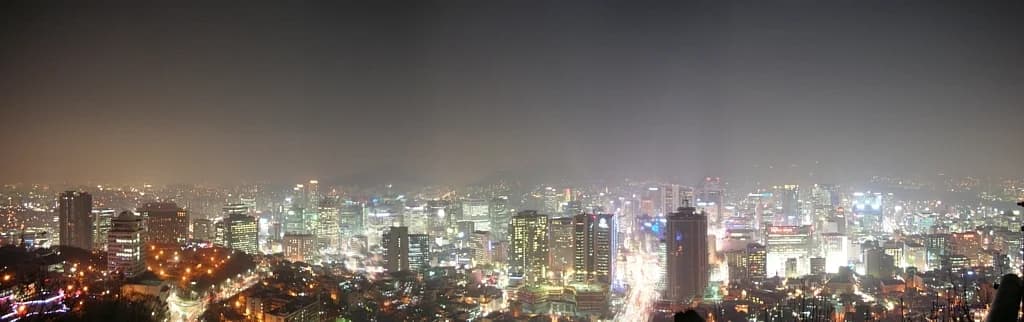
Seoul is a city that has done more with less time than any urban centre on Earth. Sixty years ago, it was a war-ravaged capital of a divided nation — its palaces reduced to rubble, its economy in ruins, its future uncertain. Today it is the fourth-largest metropolitan economy in the world, a city of fifteen million that has produced Samsung, BTS, a film industry that won the Oscar for Best Picture, and a cultural export machine — K-pop, K-drama, K-beauty, K-food — that has reshaped global taste. The transformation is so rapid, so total, that it can feel disorienting: one moment you are walking through a neighbourhood of glass skyscrapers and underground shopping malls, and the next you turn a corner into an alley where an elderly woman is selling roasted chestnuts from a charcoal brazier, and the twenty-first century falls away like a dropped call.

/images/experiences/25-seoul/img-01.webp
Gyeongbokgung was built in 1395 by King Taejo, founder of the Joseon Dynasty, and served as the principal royal residence for over 500 years across two distinct periods — before and after the Japanese invasions of the 1590s left it in ashes for 273 years. The current palace complex is the result of a massive reconstruction begun under Prince Regent Heungseon Daewongun in 1867, involving over 500 buildings across 40 hectares. The painted beams — dancheong — employ five traditional colours (blue, red, yellow, white, and black) representing the cardinal directions and the five elements of East Asian cosmology, and the patterns are periodically refreshed by master artisans trained in techniques documented in royal archives.
Photo: Photo courtesy of Korea Tourism Organization
The Joseon Dynasty, which governed Korea from 1392 to 1910, built Seoul as its capital, and the five royal palaces — Gyeongbokgung, Changdeokgung, Changgyeonggung, Deoksugung, and Gyeonghuigung — are its most enduring architectural legacy. To walk the grounds of these palaces, with their painted wooden pavilions, their ceremonial halls, and their Secret Gardens of ponds and pavilions, is to understand that Seoul's modernity is not a rejection of its past but an extension of it — a dynasty of innovation that has simply traded silk robes for semiconductor factories.
Gyeongbokgung: The Grandest Palace
Gyeongbokgung, the "Palace Greatly Blessed by Heaven," was the principal royal residence of the Joseon Dynasty. Built in 1395 and rebuilt in 1867 after being destroyed by the Japanese invasions of the sixteenth century, it is a complex of stunning scale and beauty — 7,700 rooms distributed across 40 hectares of courtyards, gardens, and ceremonial halls. The centrepiece is Geunjeongjeon, the throne hall, where the king received foreign envoys and conducted affairs of state from a raised platform beneath an elaborately painted ceiling.
The changing of the royal guard ceremony, held at the Gwanghwamun Gate every day except Tuesday at 10 am and 2 pm, is a re-enactment of Joseon-era pageantry that avoids the kitsch into which such performances so easily descend. The guards, in their crimson and blue silk robes, carrying traditional weapons with bladed tips that catch the light, perform their ritual with a solemnity that commands respect. Arrive fifteen minutes early for a good viewing position.
But the palace's finest hour is at the end of the day. As the sun drops behind the Bukhansan mountain range to the north, the painted beams of the pavilions turn gold and crimson, the shadows lengthen across the courtyards, and the crowds thin to a handful of photographers and couples walking hand in hand. The palace closes at 6 pm (5 pm in winter), and the last hour, when the light is at its most beautiful, is the time to be there.

/images/experiences/25-seoul/img-02.webp
Geunjeongjeon, the throne hall of Gyeongbokgung, was the ceremonial heart of the Joseon Dynasty, where the king received foreign envoys, proclaimed laws, and conducted the grandest affairs of state from a raised throne beneath an elaborately carved canopy of dragons. The hall's double-tiered roof and central bay height exceed those of any other building in the palace complex, a deliberate architectural assertion that this was the seat of royal authority itself. The stone courtyard markers — pumgye-seok — indicate where officials of different ranks stood during ceremonies, with the highest-ranking ministers nearest the throne, their positions frozen in granite as a permanent reminder of the rigid Confucian hierarchy that governed the Joseon court.
Photo: Photo courtesy of Korea Tourism Organization
Changdeokgung and the Secret Garden
Changdeokgung, a UNESCO World Heritage Site, is the best-preserved of Seoul's five palaces and, for many visitors, the most beautiful. Built in 1405 as a secondary palace, it became the principal royal residence after Gyeongbokgung was destroyed, and its architecture is more intimately integrated with its natural setting. The buildings seem to grow from the hillside, their eaves echoing the curves of the surrounding forest, their courtyards opening onto views of gardens and distant mountains.
The Huwon, or Secret Garden, is Changdeokgung's greatest treasure — a 78-acre landscape of ponds, pavilions, and forest that served as the private retreat of the Joseon royal family. Access is by guided tour only, and places fill quickly; book online in advance. The tour takes ninety minutes and wanders through a landscape that is not, in the European sense, a "garden" at all — there are no geometric flowerbeds, no manicured lawns — but a curated wilderness, a sequence of views and experiences designed to harmonise with nature rather than subdue it. The Buyongji pond, with its circular island and its pavilion reflected in the dark water, is a composition of such tranquil beauty that it feels less like a landscape and more like a poem rendered in water, stone, and wood.

/images/experiences/25-seoul/img-03.webp
The Huwon, or Secret Garden, of Changdeokgung spans 78 acres of naturalistic landscape that was designed not as a garden in the European sense but as a curated wilderness — a philosophy of landscape architecture in which human intervention is deliberately invisible. The Buyongji pond, with its circular island representing the Daoist paradise of the immortals, was the setting where King Jeongjo (r. 1776-1800) composed poetry and held scholarly debates with the finest minds of the Joseon court. The garden's survival through Japanese occupation, the Korean War, and Seoul's relentless development is a minor miracle — and its UNESCO inscription in 1997 recognised it as an outstanding example of Far Eastern palace garden design.
Photo: Photo courtesy of Korea Tourism Organization
“Seoul is not a city that asks to be loved. It is a city that demands to be reckoned with — and in the reckoning, you discover that love has already arrived.”
Insadong and Bukchon: The Old City, Alive
Between Gyeongbokgung and Changdeokgung lies Insadong, the cultural artery of Seoul, where the city's traditional crafts — ceramics, calligraphy, hanji paper, antique furniture — are sold from shops whose proprietors are often masters of the crafts they purvey. The main street, a pedestrian-friendly thoroughfare of galleries, tea houses, and restaurants, is touristy in the best sense: popular enough to be accessible, authentic enough to reward serious exploration. The side alleys, where small galleries show contemporary Korean art and tea houses serve infusions of omija (five-flavour berry) in rooms of polished wood and paper screens, are where Insadong's true treasures lie.
Bukchon Hanok Village, between the two palaces, is a neighbourhood of some 900 traditional Korean houses — hanok — that have been preserved and, in many cases, restored to their Joseon-era appearance. The hanok, with their grey-tiled roofs curving upward at the eaves, their wooden pillars, and their internal courtyards, represent a residential architecture of extraordinary elegance and practicality: the ondol under-floor heating system, still in use today, was keeping Korean houses warm centuries before European homes had anything comparable. Many of the hanok are still private residences; walk the narrow lanes quietly and respectfully, and remember that the elderly woman sweeping her courtyard is not a museum exhibit.
Myeongdong and the Beauty Empire
Myeongdong is Seoul's commercial heart — a dense grid of cosmetics shops, fashion boutiques, department stores, and street-food stalls that throbs with the energy of a city that has turned shopping into a competitive sport. The Korean beauty industry, which has more or less conquered the global skincare market, is headquartered here: Innisfree, Laneige, Sulwhasoo, Missha, and a dozen other brands operate flagship stores where the sales assistants wear headsets, the testers cover every available surface, and the sheet masks — Korea's great gift to skincare — are sold in quantities that suggest they are a staple food group.
The street food of Myeongdong is a parallel attraction. Stalls sell tteokbokki (cylindrical rice cakes in a fiery red chilli sauce), hotteok (sweet pancakes filled with brown sugar and nuts), and tornado potatoes — a spiral-cut potato on a stick, fried and dusted with chilli powder — that are entirely irresistible. The dining in Myeongdong's restaurants, from Korean barbecue to fried chicken to the legendary Myeongdong Kyoja (a noodle restaurant that has been serving the same kalguksu — knife-cut wheat noodles in chicken broth — since 1966), rewards the hungry shopper with a stamina that mere sightseeing does not require.
The Korean Food Renaissance
Korean cuisine — hansik — has, in the past decade, emerged from the shadow of its Japanese and Chinese neighbours to claim its place as one of the great culinary traditions of Asia. The foundation of every Korean meal is banchan — the small side dishes that arrive before the main course and cover the table in a mosaic of colours, textures, and fermented flavours. Kimchi, the most famous banchan, is a universe in itself: over 200 documented varieties, from the classic baechu (napa cabbage) to kkakdugi (cubed radish) to the exquisite bossam kimchi of the northern regions, each one a different expression of the Korean genius for fermentation.
Korean barbecue — gogigui — is the experience that most visitors seek out, and Seoul delivers it at every price point. The premium Hanwoo beef, Korea's indigenous cattle breed, compares favourably with Japanese wagyu — less extravagantly marbled but more intensely beefy, with a flavour that lingers on the palate long after the last piece has been grilled and wrapped in a lettuce leaf with ssamjang (fermented soybean paste) and a slice of raw garlic. The best Hanwoo can be found at specialist restaurants like Born and B in Cheongdam-dong, where the beef is dry-aged in-house and the grilling is done over binchotan charcoal.
At the more accessible end of the spectrum, the gamjatang (pork-bone soup) joints of Mapo-gu, the samgyeopsal (pork belly) restaurants of Hongdae, and the fried chicken and beer — chimaek — establishments that blanket the city are reminders that Korean cuisine is, at its core, democratic: designed to be shared, enjoyed loudly, and accompanied by copious quantities of soju, the clear, slightly sweet spirit that is Korea's national drink.

/images/experiences/25-seoul/img-04.webp
Hanwoo, Korea's indigenous cattle breed, descended from a small population of native Korean cattle that has been genetically isolated for millennia, with archaeological evidence suggesting domestication as early as 2000 BC. Unlike wagyu, which is graded primarily on marbling fat content, Hanwoo is prized for its rich beefy flavour and a specific balance of oleic acid that gives the meat a distinctive nuttiness — comparable to high-end Iberian pork. The banchan array surrounding the grill is the legacy of Korea's royal court cuisine, where meals were served with up to twelve side dishes; today, even the humblest barbecue restaurant presents a kaleidoscope of kimchi, pickled vegetables, and fermented pastes that represent the collective wisdom of Korean fermentation science.
Photo: Photo courtesy of Korea Tourism Organization
Hongdae and Gangnam: The Two Faces of Seoul Nightlife
Hongdae, the district around Hongik University, is Seoul's youth-culture capital — a district of indie music clubs, street performances, vintage shops, and themed cafes (cat cafes, dog cafes, raccoon cafes, and the inevitable K-pop cafes) that hums with the energy of a student population on permanent creative overdrive. The streets on a weekend evening are a carnival of buskers — dance troupes, acoustic guitarists, rap battlers — drawing crowds that shift and reform like flocks of starlings.
Gangnam, by contrast, is Seoul's wealth and aspiration, rendered in glass and marble. The district that Psy's 2012 earworm made globally famous is the centre of Korea's luxury industry — flagships of Chanel, Hermès, and Louis Vuitton line the streets, and the plastic surgery clinics for which Seoul is (in)famous cluster around Apgujeong Station. The nightlife here is more polished, more expensive, and correspondingly more exclusive: cocktail bars where the bartenders wear white jackets and the ice is carved into spheres of perfect clarity, clubs where the door policy is mysterious and absolute.
Navigating Seoul
Seoul's subway system is one of the world's best — clean, efficient, and comprehensively signed in English. Get a T-money card at any convenience store; it works on subways, buses, and even in taxis. The subway app (KakaoMetro or Naver Map — Google Maps is, mysteriously, less reliable in South Korea) will plan your route to the minute. Taxis are plentiful and inexpensive by global standards; the KakaoTaxi app summons them with the ease of Uber.
Frequently Asked Questions
When is the best time to visit? April through June (spring) and September through November (autumn) offer the most pleasant weather and the most beautiful light. Cherry blossoms bloom in early April — the Yeouido Spring Flower Festival draws enormous crowds. Autumn brings golden ginkgo trees and crisp, clear days. Summer (July-August) is hot, humid, and punctuated by monsoon rains. Winter (December-February) is cold and dry, but the city is quiet, the hotteok (sweet pancakes) taste better in the cold, and the palace snowscapes are magical.
How many days do I need? Four full days is a solid introduction: one for the palaces and Insadong, one for Bukchon, Myeongdong, and the markets, one for Hongdae, Gangnam, and contemporary Seoul, and one for a day trip — either to the DMZ (a sobering, essential experience) or to the fortress city of Suwon. Five to seven days allows for a deeper culinary exploration and day trips to the mountains that surround the city.
Do I need to speak Korean? No — English signage is pervasive, and younger Koreans generally speak at least basic English. But a few phrases — annyeong haseyo (hello), kamsahamnida (thank you), juseyo (please) — will be warmly received, and the effort, however imperfect, is always appreciated.
Is Seoul expensive? By Asian standards, moderate. A Korean barbecue dinner for two costs ₩40,000-80,000. A bowl of naengmyeon (cold noodles) costs ₩8,000-12,000. A luxury hotel room costs ₩300,000-800,000; a comfortable mid-range hotel, ₩100,000-200,000. Compared to Tokyo, Seoul is a bargain. Compared to Southeast Asia, it is expensive. The value for money, across the board, is exceptional.
What about the DMZ? The Korean Demilitarised Zone, approximately an hour north of Seoul, is one of the most surreal and sobering destinations in the world. Visits must be arranged through an approved tour operator; book several days in advance, bring your passport, and dress conservatively (no shorts, no ripped jeans, no clothing with political messages). The experience — standing in a small blue building that straddles the border, looking across at a North Korean guard who is looking back at you — is one you will carry for the rest of your life.

/images/experiences/25-seoul/img-06.webp
N Seoul Tower, completed in 1975 on the summit of Namsan mountain at 236 metres above the city, was Korea's first general-communications tower and remains the highest point in Seoul's city centre when combined with its 236.7-metre mast. The tower's observation deck offers the only 360-degree view in the city where all 25 districts — gu — of Seoul are visible simultaneously, from the neo-futurist towers of Gangnam to the ancient city walls snaking across the peaks of Bugaksan and Inwangsan. The "Locks of Love" installation on the tower's plaza, where couples attach padlocks to the railings and throw the keys away, has become one of Asia's most popular romantic rituals — a contemporary folk tradition that draws an estimated 8.4 million visitors annually.
Photo: Photo courtesy of Korea Tourism Organization