Busan is the city Seoulites escape to — a coastal metropolis wedged between mountains and the Sea of Japan (or East Sea, as Koreans prefer), where the pace slows, the seafood is fresher than anything in the capital, and the light, filtered through salt air and mountain mist, has a quality that painters have been chasing for centuries. South Korea's second city — five million people in the greater metropolitan area — is less polished than Seoul, less relentless, and correspondingly more relaxed. It is a city of beaches and temples, fish markets and hot springs, where the mountains meet the sea with a drama that makes every journey across town a scenic experience.

/images/experiences/24-busan/img-01.webp
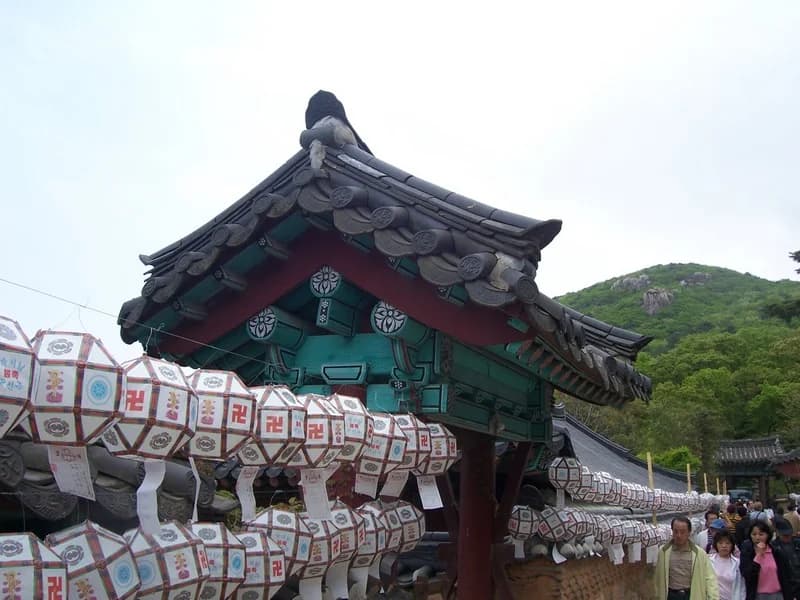
Haedong Yonggungsa, founded in 1376 by the revered Goryeo-era monk Naong Hyegeun during a time of devastating drought, is one of the few Buddhist temples in Korea built directly on the coast rather than in the mountains. The temple was destroyed during the Japanese invasions of the 1590s and lay in ruins for nearly three centuries before being reconstructed in the 1930s, then painstakingly restored again in the 1970s. The 108 stone steps descending to the temple complex are symbolically significant — in Buddhist cosmology, 108 represents the number of earthly desires and passions that must be overcome to reach enlightenment, and each step downward is a conscious act of renunciation.
Photo: Photo courtesy of Korea Tourism Organization
The city's geography is its destiny. Busan is built on a narrow coastal plain, squeezed between the sea and a ring of mountains that rise steeply from the urban edge — Geumjeongsan to the north, Jangsan to the east, and the Nakdong River delta to the west. The result is a vertical city: neighbourhoods stacked on hillsides, connected by staircases and narrow roads, each one offering a different view of the sea. This topography gives Busan a texture that flatter cities lack. The best views — and some of the best experiences — require climbing.
Haedong Yonggungsa: The Temple at the Edge of the Sea
Most Buddhist temples in Korea are built in the mountains, where the air is thin and the distractions are few. Haedong Yonggungsa, on Busan's northeastern coast, is the magnificent exception. Founded in 1376 by the great Goryeo-era monk Naong Hyegeun, it occupies a rocky promontory that juts into the East Sea, its golden Buddha statues and painted pavilions clinging to cliffs above the crashing surf. The approach — descending 108 stone steps through a forest of pine and cherry — is a deliberate preparation: you leave the world behind with each step.
The temple's most spectacular feature is the Haesu Gwaneum Daebul, a ten-metre bronze statue of the Goddess of Mercy that gazes out over the sea from a granite pedestal at the cliff's edge. The statue catches the sunrise, turning from dark bronze to liquid gold as the first rays strike it, and the experience of standing before it at dawn — the sea below, the gulls wheeling overhead, the chants of the morning ceremony drifting from the main hall — is, for believers and non-believers alike, a moment of genuine transcendence.
Go at sunrise, before the tour buses arrive. The temple opens at 5 am, and the dawn light, the empty courtyards, and the sound of the sea unaccompanied by selfie-stick wielding crowds is a gift you give yourself.

/images/experiences/24-busan/img-02.webp
The Haesu Gwaneum Daebul, or Great Seawater Avalokiteshvara, is a ten-metre-tall bronze statue of the Buddhist Goddess of Mercy that stands on a granite pedestal at the very edge of the temple's rocky promontory. Unlike temple statues placed within halls for protection, this Gwaneum faces the open sea, embodying her role as the hearer of the cries of the world — particularly the prayers of fishermen and sailors who have sought her protection for centuries. The statue was cast using traditional Korean bronze techniques that include small amounts of gold in the alloy, which is why the first rays of sunrise appear to set the figure ablaze with an inner radiance.
Photo: Photo courtesy of Korea Tourism Organization
Haeundae and Gwangalli: The Beaches of Busan
Haeundae Beach is Korea's most famous strip of sand, and in summer — July and August — it is a spectacle of dense humanity: a kilometre and a half of golden sand covered in parasols, inflatable floats, and the bronzed bodies of a nation that takes its beach culture seriously. The scene is chaotic, joyful, and entirely Korean — the fried chicken and beer arrive at your beach mat via delivery services that navigate the crowds with uncanny precision, and the people-watching is world-class. If you are in Busan in summer, Haeundae is an essential experience.
If you are in Busan in any other season, Haeundae offers a different, perhaps more beautiful, experience. The beach, empty of crowds, becomes a place of quiet, windswept beauty — the winter waves roll in from the open sea, the gulls patrol the shoreline, and the cafés along the boardwalk serve hot coffee with a view of the grey-green water. The Haeundae Sky Capsule, a monorail of brightly coloured carriages that runs along the coastline from Mipo to Cheongsapo, offers spectacular views of the sea and the city from a height that is exhilarating without being terrifying.
Gwangalli Beach, forty minutes south, is Haeundae's hipper, younger sibling — a curve of sand facing the Gwangan Bridge, a two-level suspension bridge that, at night, becomes a canvas for one of Korea's most sophisticated LED light displays. The bridge transforms from rose to violet to emerald, the lights reflecting in the dark water, and the beachside bars and restaurants, their terraces filled with couples and groups of friends, create an atmosphere that is part Miami, part Seoul, and entirely Busan.
Jagalchi: The Fish Market That Never Sleeps
Jagalchi Fish Market, occupying a sprawling complex on the Nampo-dong waterfront, is Korea's largest seafood market and Busan's most vivid sensory experience. The ground floor is a wet market of staggering variety — tanks of live fish, trays of glistening shellfish, octopus still moving in their shallow pools, and the ajummas (middle-aged women in rubber boots) who are the market's legendary vendors, their voices slicing through the salty air as they call out prices and exchange banter with their regular customers.
The upper floors are where you eat. Select your fish on the ground floor, and the vendor will send it upstairs to a restaurant that will prepare it for immediate consumption — sashimi, grilled, or in a spicy stew, maeuntang, that is Korea's answer to bouillabaisse. The sashimi — hwae — is the purest expression of the market's quality: sliced to order, the fish so fresh it is still contracting slightly on the plate, served with ssamjang, gochujang, and a basket of lettuce leaves for wrapping. A meal at Jagalchi is not merely a meal. It is an encounter with the ocean itself, mediated by the skill of the ajummas who have been plying this trade since before the skyscrapers rose on the shoreline.

/images/experiences/24-busan/img-03.webp
Jagalchi, Korea's largest seafood market, traces its origins to the period after the Korean War when women who had lost husbands and fathers in the conflict began selling fish on the Nampo-dong waterfront to support their families. The ajummas — the legendary "Jagalchi grandmothers" — evolved into a formidable economic force, collectively dominating Busan's seafood trade through sheer determination and business acumen. The modern market complex, opened in 2008, spans seven floors and incorporates both the traditional wet market on the ground floor and the elaborate restaurant setup upstairs, where still-twitching fish travel from tank to table in under ten minutes.
Photo: Photo courtesy of Korea Tourism Organization
“Busan without Jagalchi would be like Paris without the Seine — a city that had lost its connection to the element that made it.”
Gamcheon: The Machu Picchu of Korea
Gamcheon Culture Village began as a settlement of Korean War refugees in the 1950s, a hillside shantytown that clung to the slopes of Cheonmasan mountain in a vertical tangle of narrow alleys and improvised dwellings. In 2009, the city government, in a rare act of municipal imagination, commissioned artists to transform the village — not to demolish and rebuild, but to decorate, enhance, and celebrate what was already there. The result is a hillside of brightly coloured houses, painted murals, and sculptural interventions that has become one of Korea's most photographed destinations.
Gamcheon walks a fine line between authentic community and tourist attraction, and it does not always stay on the right side of it. The residents, many of them elderly, are not performers in a theme park, and the constant stream of visitors can feel intrusive. Visit early in the morning, before the crowds arrive; stay on the designated walking routes; and remember that people live here. The Little Prince statue, overlooking the village from a hillside platform, is the most popular photo spot — arrive before 9 am for a chance at a crowd-free shot.

/images/experiences/24-busan/img-04.webp
Gamcheon began in the 1950s as a settlement of Korean War refugees who built makeshift homes on the steep slopes of Cheonmasan — land that no developer wanted and no government planner contested. In 2009, the Busan city government's "Dreaming of Machu Picchu in Busan" project invited artists to transform the neighbourhood through murals, sculptures, and creative placemaking, deliberately preserving the village's labyrinthine alleyways and working-class character. The pastel-coloured houses, many still occupied by the original refugee families or their descendants, now form one of Asia's most photogenic urban landscapes — though visitors are reminded that roughly 10,000 people call this hillside home, and the photographer's whimsical backdrop is someone else's living room.
Photo: Photo courtesy of Korea Tourism Organization
The Spa and the Temple: A Day of Peace
Busan is Korea's hot-spring capital, and the jjimjilbang — the Korean bathhouse and sauna — is a cultural institution as essential as the temple or the market. Spa Land, in the Shinsegae Centum City complex (the world's largest department store, according to the Guinness Book of Records), is the most polished entry point — eighteen themed saunas, outdoor foot baths, and relaxation areas where Koreans of all ages nap on heated floors, watch television, and snack on baked eggs. The experience — scrubbing, soaking, sweating, and the profound relaxation that follows — is a window into a Korean approach to wellness that has nothing to do with the wellness-industrial complex.
Beomeosa Temple, on the slopes of Geumjeongsan mountain, is the city's most important Buddhist complex and a counterweight to the coastal temples. Founded in AD 678, it was rebuilt after the Imjin War of the 1590s and remains an active monastic community. The hike up from the city, through pine forests that grow denser and quieter as you ascend, deposits you at a complex of painted wooden halls, stone pagodas, and a profound silence broken only by the wind in the pines and the distant chanting of monks. The temple stay program — overnight accommodation in the monastic quarters, participation in morning meditation and chanting — is available to visitors of all faiths and none.
Haeundae Alternatives
Songjeong Beach, twenty minutes' drive north of Haeundae, offers cleaner water, fewer crowds, and better surfing. The cafés along the shore serve excellent coffee and pastries, and the atmosphere is more Byron Bay than Cancun. It is particularly good in the shoulder seasons — May, June, September, October — when the water is still warm enough for swimming and the summer crowds have not yet arrived.
Frequently Asked Questions
How many days do I need? Three full days is the minimum for a meaningful introduction: one day for the temples (Haedong Yonggungsa and Beomeosa), one for the markets and beaches (Jagalchi, Haeundae, Gwangalli), and one for Gamcheon, the museums, and a jjimjilbang. Four to five days allows for a more leisurely pace and side trips.
How do I get from Seoul to Busan? The KTX bullet train from Seoul Station to Busan Station takes two hours and thirty minutes (₩59,800 in standard class). Flights from Gimpo to Gimhae Airport take one hour but are not significantly faster when travel to and from airports is factored in. The train, with its views of the Korean countryside — rice paddies, mountains, the occasional glimpse of a small town — is the more civilised option.
What is the best area to stay? Haeundae for beach access, luxury hotels (Paradise Hotel, Signiel Busan, Park Hyatt Busan), and proximity to the eastern temples. Nampo-dong for the markets (Jagalchi, Gukje), the old city, and a more local atmosphere. Gwangalli for a younger, hipper vibe and the Gwangan Bridge light show.
What about the language barrier? Busan has less English than Seoul, and the local dialect — satoori — is famously distinct. The usual tools — Google Translate camera, a few phrases of Korean, a smile — will get you through most situations. The Jagalchi ajummas, in particular, will understand your order regardless of language.

/images/experiences/24-busan/img-05.webp
Gwangandaegyo, or the Gwangan Bridge, is a 7.4-kilometre double-deck suspension bridge completed in 2002 that connects Haeundae-gu to Suyeong-gu across the mouth of the Suyeong River. Its LED illumination system, installed in 2011 and upgraded in 2018, uses over 180,000 individually programmable LEDs to create a nightly light show — the seasonal colour palettes shift from cherry-blossom pink in spring to deep indigo in summer and amber-gold in autumn. The bridge has become the centrepiece of Busan's annual International Fireworks Festival, one of Asia's largest pyrotechnic events, which draws over a million spectators to Gwangalli Beach each October.
Photo: Photo courtesy of Korea Tourism Organization