Kyoto is not merely a city — it is the memory of Japan rendered in cypress wood, raked gravel, and the scent of incense drifting through centuries-old temples. For over a thousand years, from 794 to 1868, this basin cradled by mountains on three sides served as the imperial capital, and every era left its mark: a temple here, a garden there, a tea house tucked behind a bamboo fence, a stone path worn smooth by the sandals of courtiers and monks. Today, Kyoto holds seventeen UNESCO World Heritage sites within its boundaries — a density of cultural treasure that few cities on earth can rival — yet it wears its significance lightly, the way a master calligrapher executes a single stroke after decades of practice. It is a city that asks you to slow down, to notice the moss on a stone lantern, to understand that the steam rising from a bowl of matcha carries the same warmth it carried for a sixteenth-century tea master. There is no checklist for Kyoto, only a deepening of attention.

/images/experiences/21-kyoto/img-01.webp
Built in 1397 as a retirement villa for Shogun Ashikaga Yoshimitsu and converted to a Zen temple after his death, Kinkaku-ji represents the pinnacle of Muromachi-period architecture. The current structure dates to 1955 after a young monk burned the original to the ground — an act of destruction driven by an obsession with its beauty that Yukio Mishima later immortalised in his novel. Each of the three tiers reflects a different architectural style — Heian shinden-zukuri on the ground floor, samurai buke-zukuri on the middle, and Zen Buddhist on the top — unified by the radiant gold leaf that covers all but the ground floor.
Photo: Photo courtesy of Kyoto City Tourism Association
Start with the temples, but do not try to see them all — that way lies exhaustion rather than enlightenment. Kinkaku-ji, the Temple of the Golden Pavilion, is the postcard icon: three stories sheathed in gold leaf, topped with a bronze phoenix, poised above a pond that mirrors its brilliance with unnerving fidelity. The original was built as a retirement villa for Shogun Ashikaga Yoshimitsu in 1397 and converted to a Zen temple after his death; the current structure dates to 1955, a meticulous reconstruction after a young monk, unhinged by its beauty, burned it to the ground — a story that Yukio Mishima immortalised in his novel *The Temple of the Golden Pavilion*. Go at opening time, 9 am, to experience it before the tour groups arrive, and walk clockwise around the pond to see how the light changes the gold from honey to brass to a pale, almost liquid shimmer.
A twenty-minute walk or a short taxi ride east brings you to Ryoan-ji, home to Japan's most famous rock garden. Fifteen stones, arranged in five clusters, float in a sea of white gravel raked into perfect parallel lines. The garden's designer is unknown; its meaning remains deliberately elusive. Sit on the wooden veranda of the Hojo hall and let your eyes adjust. You will notice that from no single vantage point can you see all fifteen stones simultaneously — a koan rendered in granite and gravel. The temple grounds also house a lovely pond garden, Kyoyochi, best visited in spring when the cherry blossoms frame the water, or in November when the maples turn the colour of embers.
“In Kyoto, beauty is not a decoration but a discipline — a way of seeing that takes a lifetime to cultivate.”
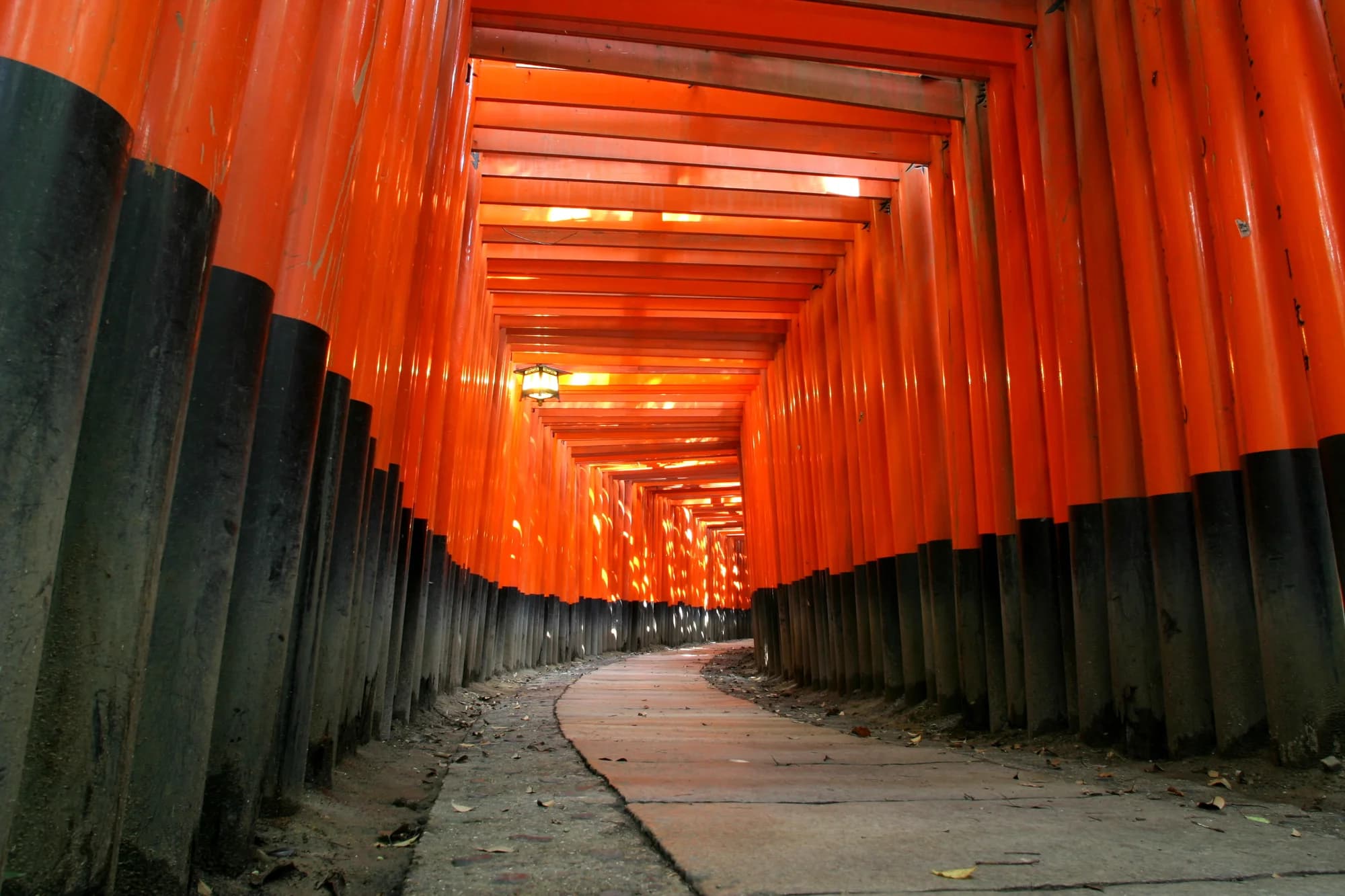
No image of Kyoto is more indelible than Fushimi Inari Taisha, the Shinto shrine on the lower slopes of Mount Inari whose vermilion torii gates — more than ten thousand of them — form tunnels of brilliant orange-red that wind uphill for four kilometres through a forest of Japanese cedar. The gates are donations from individuals and corporations seeking prosperity (Inari is the god of rice and business), and each is inscribed with the donor's name and the date of the gift. The full loop to the summit and back takes two to three hours; if you start at dawn or late afternoon, the light filtering through the gates creates corridors of almost supernatural radiance, and the crowds thin enough that you might walk for minutes without encountering another soul. Small sub-shrines, fox statues wearing red bibs, and tea stalls punctuate the ascent. The foxes are *kitsune*, Inari's messengers, and their keen, intelligent faces watch you from every clearing.

/images/experiences/21-kyoto/img-02.webp
Fushimi Inari Taisha, founded in AD 711, is the head shrine of Inari — the Shinto god of rice, sake, and prosperity — serving over 30,000 sub-shrines across Japan. Each of the more than 10,000 torii gates lining the four-kilometre trail up Mount Inari was donated by an individual or corporation seeking divine favour, with the donor's name and date inscribed on the back in black calligraphy. The brilliant vermilion colour, achieved through a coating of mercury-based lacquer, symbolises protection against evil forces and has been the hallmark of Inari shrines since the eighth century.
Photo: Photo courtesy of Japan National Tourism Organization
The Higashiyama district, stretching between Kiyomizu-dera and Yasaka Shrine, is the Kyoto of the imagination — narrow lanes lined with wooden machiya townhouses, their latticed windows and noren curtains unchanged for a century or more. Kiyomizu-dera itself, a UNESCO site founded in 778, is famous for its wooden terrace that juts out over a hillside supported by 139 pillars, not a single nail used in the joinery. The expression "to jump off the stage of Kiyomizu" is the Japanese equivalent of "taking the plunge." The view from the terrace sweeps across the city to the Arashiyama mountains, and in spring the hillside erupts in pink, while autumn sets it ablaze in red and gold. Walk downhill through the preserved streets of Sannenzaka and Ninnenzaka — steep, stone-paved slopes where it is said that if you stumble, you will die within two or three years. The slopes are lined with shops selling Kiyomizu-yaki pottery, pickles, and sweets, and it is worth pausing for a cup of matcha at one of the tea houses overlooking the pagoda of Yasaka.
Then there is Gion. The geisha district of Kyoto, particularly the streets of Hanami-koji and Shirakawa, is among the most beautiful urban landscapes in the world: dark wooden facades, paper lanterns glowing at dusk, willow branches trailing in the canal, and, if you are fortunate, the glimpse of a geiko (as Kyoto's geisha are properly called) or maiko apprentice clip-clopping to an engagement in her wooden okobo sandals. Gion at twilight, just as the lanterns are lit and the first guests arrive at the ochaya tea houses, has the quality of a dream half-remembered. Be respectful — the women are artists and professionals, not tourist attractions. Book a cultural experience through a reputable agency if you wish to witness a performance of traditional dance and music. For dinner, Gion is home to some of Kyoto's finest kaiseki restaurants, including the three-Michelin-starred Kikunoi, where chef Yoshihiro Murata transforms seasonal ingredients into edible poems: a single bamboo shoot in spring broth, ayu sweetfish grilled over binchotan charcoal in summer, matsutake mushroom in an earthenware pot come autumn.

/images/experiences/21-kyoto/img-03.webp
A maiko is an apprentice geiko (the Kyoto term for geisha), undergoing approximately five years of rigorous training in traditional dance, music, tea ceremony, and the art of conversation before debuting as a full geiko. Her elaborate silk kimono with its long trailing obi, the seasonal floral ornaments in her hair, and the distinctive white makeup with a crescent of bare skin at the nape all follow conventions established in the Edo period. Gion, developed in the 16th century to serve visitors to Yasaka Shrine, remains the most exclusive of Kyoto's five geiko districts, its wooden machiya facades and narrow lanes preserved under the city's strict architectural codes.
Photo: Photo courtesy of Kyoto Convention & Visitors Bureau
Kaiseki — Japan's ultimate culinary art — reached its apotheosis in Kyoto, and no visit is complete without experiencing it. Derived from the simple meals served alongside the tea ceremony, kaiseki evolved into a multi-course progression that honours seasonality, texture, colour, and temperature with the precision of a symphony. A proper kaiseki meal might begin with a *sakizuke* (appetiser) of sesame tofu and sea urchin, move through a clear soup, sashimi, grilled and steamed courses, and conclude with rice, pickles, and a delicate sweet. Kyoto's kaiseki restaurants range from the sublime (Hyotei, a three-Michelin-star institution operating from a 400-year-old tea house) to more accessible options like Giro Giro Hitoshina, which offers a modern, less formal interpretation. Reservations are essential, often months in advance for the top establishments; your ryokan or hotel concierge is your best ally.
Speaking of ryokan: if Kyoto offers one accommodation experience you must have, it is a night in a traditional inn. Ryokan like Tawaraya (the city's most celebrated, founded over 300 years ago and favoured by everyone from Marlon Brando to Steve Jobs), Hiiragiya, and the modern-but-traditional Seikoro offer an immersion in *omotenashi* — Japanese hospitality — that defies Western comparison. You sleep on a futon laid out on tatami mats, bathe in an ofuro tub of cedar or cypress, wear a yukata robe, and eat your breakfast and dinner in your room, each dish arriving in lacquerware like a sequence of small, perfect gifts. The gardens visible from your window, the seasonal flower arrangement in the tokonoma alcove, the calligraphy scroll — every detail is considered. It is not inexpensive, but it is the essence of Kyoto.
“Ours is not a country of philosophies but of aesthetics — and Kyoto is our reliquary.”
Cross to the western edge of the city and you reach Arashiyama, a district of temples, temples, and the famed bamboo grove that has become one of the most photographed places in Japan. The path through the towering Moso bamboo — stalks as thick as a man's thigh soaring thirty metres high — is brief, perhaps twenty minutes from end to end, but the effect is transporting: the green-filtered light, the rustle and creak of the canes in the wind, the sense of having stepped into another century entirely. Go before 7 am for solitude. Nearby, the temple of Tenryu-ji, a UNESCO site with a fourteenth-century garden designed by the Zen master Muso Soseki, offers views of the Arashiyama mountains through a frame of pine and cherry trees. The garden is an early example of *shakkei*, or "borrowed scenery," incorporating the distant landscape into the composition. Continue north along the Hozu River to the isolated temple of Otagi Nenbutsu-ji, a minor miracle of folk art where twelve hundred stone statues of the Buddha's disciples — *rakan* — line the hillside, each with a distinct, often comical expression, carved by visitors under the guidance of the temple's priest in the 1980s.
The philosopher's path, a two-kilometre stone walkway that follows a canal lined with cherry trees, connects the temple of Ginkaku-ji (the Silver Pavilion) to the neighbourhood of Nanzen-ji. It is named for Nishida Kitaro, the twentieth-century philosopher who walked this route daily in meditation. In spring, the cherry blossoms form a tunnel of pink above the water; in summer, the trees are a dense canopy of green; in autumn, the maples turn crimson; in winter, a dusting of snow transforms the scene into a sumi-e ink painting. There are small cafes, craft shops, and the exquisite temple of Honen-in along the way, where a thatched gate and mounds of raked sand mark the entrance to a mossy sanctuary that feels utterly forgotten by time.

/images/experiences/21-kyoto/img-04.webp
Named for Nishida Kitaro, the 20th-century philosopher and founder of the Kyoto School who walked this route daily in meditation, the path follows the Lake Biwa Canal for two kilometres between Ginkaku-ji and Nanzen-ji. The canal was completed in 1890 as part of Japan's first modern civil engineering project, bringing water and hydroelectric power to Kyoto's rapidly industrialising streets. The hundreds of Somei Yoshino cherry trees lining both banks were planted in the early Showa era and now form one of Japan's most celebrated sakura tunnels each spring.
Photo: Photo courtesy of Kyoto City Tourism Association
No understanding of Kyoto is complete without the tea ceremony — *chanoyu*, the Way of Tea. It is not simply a beverage; it is a choreographed ritual of hospitality, aesthetics, and Zen philosophy distilled into the act of preparing and receiving a bowl of powdered green tea. The principles, established by Sen no Rikyu in the sixteenth century, are harmony (*wa*), respect (*kei*), purity (*sei*), and tranquillity (*jaku*). Several tea houses in Kyoto offer abbreviated ceremonies for visitors, conducted in English; Camellia Tea House near Kiyomizu-dera and En Tea House in the Nakagyo ward are both excellent. You will learn to bow, to turn the bowl, to admire the utensils, and to taste the matcha — vegetal, slightly bitter, deeply calming — with attention rather than distraction.
For a more earthy immersion, Nishiki Market — "Kyoto's Kitchen" — is a five-block covered arcade in the city centre where you can taste your way through the ingredients that define the region's cuisine. Stalls sell tsukemono (pickles) in every hue, razor-thin slices of dried bonito, yuba (tofu skin, a Kyoto speciality), matcha-flavoured everything, grilled skewers of ayu, soft-serve ice cream dusted with kinako soybean powder, and the tiny, exquisite wagashi confections that accompany the tea ceremony. It is bustling, fragrant, and deeply democratic — a reminder that Kyoto's refinement is built on the skills of artisans who have been fermenting, drying, pickling, and sweetening for generations.
Timing Your Kyoto Visit
Kyoto's two peak seasons — late March to early April for cherry blossoms, and mid-November to early December for autumn foliage — are spectacular and spectacularly crowded. If you can visit in late February, the plum blossoms at Kitano Tenmangu Shrine are equally lovely and far less besieged. Early October offers warm days, cool nights, and the first hints of colour in the higher hills. July brings the Gion Matsuri, one of Japan's great festivals, with enormous floats parading through the city, but also crushing humidity. Winter (January and February) is cold, quiet, and magical — snow on temple roofs, steaming cups of amazake (sweet rice wine), and the city largely to yourself. Regardless of season, arrive at major sites by 8 am to experience them in relative peace, and save afternoons for less-trafficked corners like the Murin-an garden villa or the Okochi Sanso villa in Arashiyama.
Where to Stay
Kyoto's accommodation landscape divides broadly into three categories: the urban luxury hotel, the traditional ryokan, and the boutique newcomer. The **Park Hyatt Kyoto**, opened in 2019 in a nine-story building designed to resemble a hillside village, occupies the best location in the city — steps from Kiyomizu-dera, with views of Yasaka Pagoda from its restaurant and bar. Rooms blend contemporary Japanese design with traditional crafts; the on-site tea house is run by a fourth-generation master. **Aman Kyoto**, set in a secret garden that was once a kimono collector's estate, feels like a temple complex reinvented as a hotel — granite paths, mossy glades, an onsen fed by natural hot springs. The **Ritz-Carlton Kyoto**, on the banks of the Kamo River, counters with soaring lobbies, a stunning indoor pool, and the kaiseki restaurant Tempura Mizuki, which holds a Michelin star.
For the ryokan experience, **Tawaraya** remains the gold standard — nineteen rooms, each with its own garden, service so intuitive it feels telepathic. **Hiiragiya**, run by the same family for six generations, is a study in understated elegance, its halls polished to a mirror shine by decades of socked feet. **Seikoro**, slightly more accessible, occupies a century-old building in Higashiyama and welcomes guests with the same warmth it has offered since the Taisho era.
A new generation of boutique properties includes **Maana Kamo**, a pair of restored machiya townhouses along the Kamo River that offer full kitchens, private gardens, and the feeling of living in Kyoto rather than visiting it — bookable through their website or via Mr & Mrs Smith.
Where to Eat
Beyond the kaiseki temples mentioned earlier, Kyoto rewards the hungry traveller at every price point. **Nishiki Market** is the obvious starting point for street food, but the surrounding streets hold deeper treasures: **Honke Owariya**, founded in 1465, is the city's oldest soba restaurant, serving buckwheat noodles on lacquer trays in a serene wooden building near the Imperial Palace. **Ippudo** and **Ichiran** have outposts for quick, superb ramen, but Kyoto's regional speciality is *gyukatsu* (breaded, deep-fried beef cutlet served rare) and *saba-zushi* (pickled mackerel pressed sushi, a preservation technique dating from the days when fish travelled from the Sea of Japan to the inland capital). **Izuju**, near Yasaka Shrine, has been making saba-zushi since 1919.
For coffee, Kyoto's third-wave scene rivals any city: **% Arabica** in Arashiyama, with its view of the Togetsukyo Bridge, draws queues that snake down the street; **Weekenders Coffee**, tucked in a car park near Nishiki Market, serves pour-overs of extraordinary clarity and precision.
Getting Around
Kyoto's public transport is excellent. The city's two subway lines (Karasuma and Tozai) connect the centre with the south and east, but most of the major sights are more easily reached by bus. The Raku Bus 100 and 101 routes loop through the main temple districts; a one-day bus pass (¥700) pays for itself after three rides. Taxis are plentiful and, unlike in Tokyo, often the fastest way between points — the drivers wear white gloves, the doors open automatically, and the fares, while not cheap, are reasonable for short hops. Renting a bicycle (many hotels and guesthouses offer them, and rental shops cluster around Kyoto Station) is an ideal way to explore the flatter parts of the city, particularly the Imperial Palace Park and the Kamo River paths.
Frequently Asked Questions
**When is the best time to visit Kyoto?** The classic answer is spring (late March to early April) for cherry blossoms or autumn (mid-November to early December) for fall foliage. Both seasons deliver the postcard Kyoto — pink petals drifting into temple ponds, maples in crimson against dark wood — but both also bring peak crowds and peak hotel rates. A savvy alternative is late February for plum blossoms, late May for lush greenery and fewer tourists, or early October for pleasant temperatures and the first autumn tints.
**How many days do you need?** Four full days is the minimum to cover the highlights without sprinting: one day for Higashiyama (Kiyomizu-dera, Sannenzaka, Gion), one for the north-west (Kinkaku-ji, Ryoan-ji, Arashiyama), one for Fushimi Inari and the south-east, and one for the Philosopher's Path, Nishiki Market, and a tea ceremony. If you have a week, add a day trip to Nara (the deer park and Todai-ji's giant Buddha) and time for a cooking class or a sake brewery tour in Fushimi.
**Is Kyoto expensive?** It can be. The top ryokan and kaiseki restaurants are among the priciest in Japan, but entry-level temples cost ¥400-600, a bowl of ramen is ¥900-1,200, and the bus pass is ¥700. You can manage Kyoto on a mid-range budget if you skip the luxury ryokan and Michelin-starred dinners, stay in a machiya guesthouse or a business hotel, and eat at markets and local noodle shops.
**Is English widely spoken?** Less than in Tokyo, but more than you might fear. Hotel staff, major temple signs, and train announcements are in English. In small restaurants and shops, a smile, a few words of Japanese (*arigato gozaimasu*, *sumimasen*, *oishii*), and the Google Translate camera function will bridge most gaps. Kyoto residents are patient with visitors who make an effort.
**What should I wear to temples?** Modest, comfortable clothing and shoes that slip on and off easily — you will be removing your shoes frequently to enter temple buildings. Avoid shorts and tank tops at religious sites. In summer, carry a small hand towel for wiping sweat and a folding fan. In winter, dress in layers: temple halls can be drafty, but the walking keeps you warm between them.

/images/experiences/21-kyoto/img-05.webp
The torii gates at Fushimi Inari are replaced on a rotating basis — each gate is repainted and refurbished roughly every 10-20 years, funded by ongoing donations from worshippers. At the summit of the 233-metre trail stands the inner shrine where pilgrims have left offerings of small torii replicas for centuries. The play of light through the gates at different times of day creates dramatically different experiences — the cool, filtered green of mid-morning giving way to the blazing amber corridors of late afternoon as the sun angles through the densely packed wooden arches.
Photo: Photo courtesy of Japan National Tourism Organization