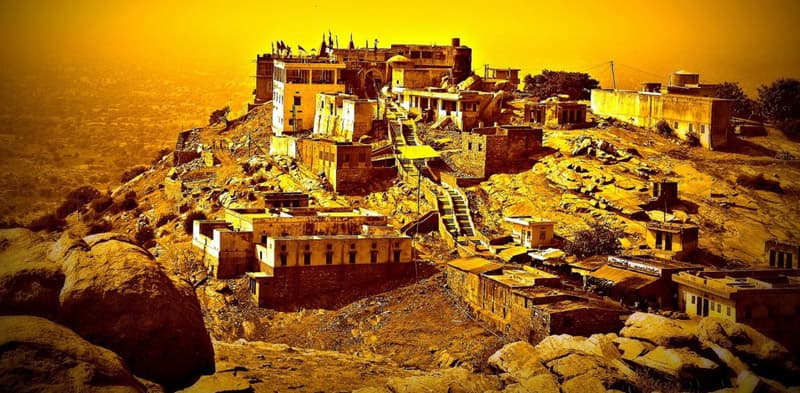
Samode Palace is not on the standard Rajasthan circuit, and that is precisely the point. Forty-two kilometres north of Jaipur, tucked into a fold of the Aravalli Hills, it occupies a geographical and cultural sweet spot: distant enough from the Pink City to feel like a genuine retreat, close enough to be reached in under an hour by car. The drive itself is a decompression — the highway gives way to a single-lane road, the road gives way to a village track, and suddenly you are climbing through the pass that opens onto the Samode valley, where the palace rises from the hillside like something from a miniature painting, all golden stone, domed chhatris, and cascading bougainvillea.
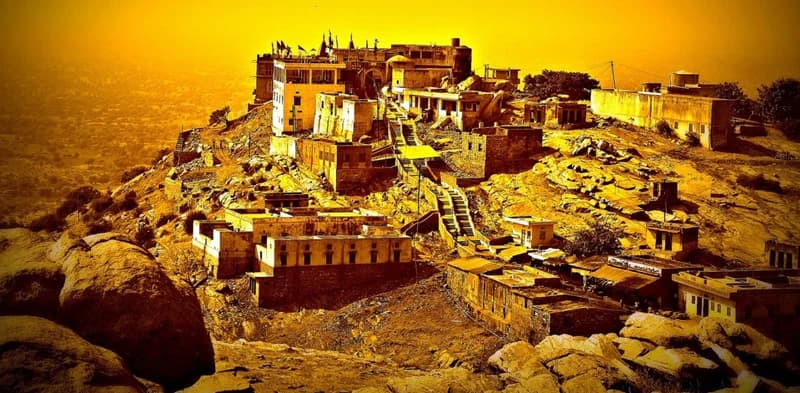
Samode Palace at golden hour — the honey-coloured facade glowing against the rugged Aravalli Hills, bougainvillea in magenta and orange cascading over ancient stone balconies, the infinity pool a rectangle of turquoise against the desert landscape
Built in the sixteenth century and expanded over 475 years by the Rawals of Samode, the palace occupies a geographical sweet spot 42 kilometres north of Jaipur — distant enough for genuine retreat, close enough to be reached in under an hour
Photo: Pcrtravel, CC BY-SA 4.0
Built in the sixteenth century by the Rawals of Samode, a noble family of the Amber kingdom, the palace has been expanded and embellished over 475 years. But its defining feature — the extraordinary painted interiors — reached their peak in the nineteenth century, when the Diwan-i-Khas (Hall of Private Audience) was decorated with floor-to-ceiling frescoes of breathtaking intricacy. The artists, working with vegetable and mineral pigments, covered every surface — walls, ceilings, arches, pillars — with scenes from Hindu mythology, floral arabesques, and geometric patterns that anticipate the fractal geometries of contemporary mathematics. The colours, softened by a century and a half of gentle Rajasthani sunlight, have aged into a palette that no decorator could replicate: dusty rose, faded indigo, ochre, sage, the pale green of oxidized copper.
The Diwan-i-Khas: A Frescoed Jewel Box
The Diwan-i-Khas is Samode Palace's masterpiece. It is not large — perhaps forty feet by twenty — but the density of its decoration is overwhelming. Every inch of the walls is painted. The ceiling is a lattice of floral patterns radiating outward from a central medallion. The arched windows, fitted with stained glass, cast coloured light onto the frescoed floor. During the day, the room glows with natural illumination; at night, when the chandeliers are lit, it transforms into a jewel box of extraordinary intimacy.
The hall was designed for private audiences — the Rawal's meetings with his ministers, visiting nobles, and the occasional British political agent. Today it serves as the palace's lounge, and taking afternoon tea here, surrounded by 150-year-old frescoes, is one of Rajasthan's most transporting experiences. The frescoes depict scenes from the life of Krishna — his childhood in Vrindavan, his dance with the gopis, his triumph over the serpent Kaliya — but they also include secular subjects: hunting scenes, court processions, floral patterns that seem to have been painted for the sheer joy of colour and form. The artists' names are lost, but their work survives, and it is, without exaggeration, among the finest fresco painting in Rajasthan.
The Diwan-i-Khas at Samode Palace — walls, ceiling, and arches covered in nineteenth-century frescoes depicting Krishna's life, floral arabesques, and geometric patterns, their vegetable-dye colours softened by a century of gentle sunlight
The artists, working with pigments of ground lapis lazuli, terra verte, and iron oxide, covered every surface — the colours have aged into a palette no decorator could replicate: dusty rose, faded indigo, ochre, sage, the pale green of oxidized copper
“Samode is not a palace you visit. It is a palace you inhabit — and the longer you stay, the more it reveals.”
The Rooms: Individual, Atmospheric, Unrepeatable
Samode Palace has 43 rooms and suites, and no two are alike. This is partly the consequence of a building that has grown organically over five centuries — no two chambers are the same shape, no two windows share the same view — and partly a deliberate philosophy. The owners, the Rawal family who still manage the property, have resisted the homogenising impulse that makes so many luxury hotels interchangeable. You could not mistake Samode for any other palace hotel in India.
The Maharaja Suite is the property's finest accommodation: a vast chamber with a canopied bed, antique furniture, frescoed ceilings, and a bathroom that was once the palace hammam. The Deori Suites, in the palace's older wing, offer frescoed walls and private terraces overlooking the courtyard. The Standard Rooms, distributed across the upper floors, are simpler but no less atmospheric — each one has its own character, its own history, its own view.
The interiors are furnished with antiques from the family's collection: brass-bound chests, carved wooden screens, miniature paintings, hand-knotted carpets. The bathrooms have been modernised — rainfall showers, deep tubs, good water pressure — but the plumbing is discreetly integrated, and the sense of inhabiting a historic space is never compromised.
The Maharaja Suite at Samode Palace — a canopied four-poster bed, frescoed ceilings, antique furniture gathered over generations, French windows opening onto a private terrace with views of the Aravalli Hills
The suite's bathroom was once the palace hammam, and the antique furniture is drawn from the Rawal family's collection — brass-bound chests, carved wooden screens, miniature paintings passed down through five centuries
The Courtyards: Architecture of Leisure
The palace is organised around a sequence of courtyards that ascend the hillside in tiers. The entrance courtyard, with its fountain and arcaded walkways, sets the tone: an architecture designed not for defence — the palace's hillside position provided that — but for pleasure, for shade, for the enjoyment of an afternoon breeze. The inner courtyard, smaller and more intimate, is where most guests gather: a marble fountain at the centre, divans arranged around the perimeter, and the palace's main restaurant opening onto the arcade.
The uppermost courtyard has been transformed into an infinity pool of startling beauty. Set against the hillside, its water the colour of a tropical sea, it looks out over the Samode valley and the Aravalli range beyond. It is not a large pool — this is not a resort — but it is one of the most beautifully situated pools in Rajasthan, and the experience of swimming in it at sunset, with the hills turning gold and the first stars appearing, is a memory that persists long after the tan has faded.
Dining: Royal Rajasthani, Served Family-Style
The restaurant at Samode Palace occupies the former zenana courtyard, the women's quarters of the palace, now covered with a retractable roof that opens to the sky on clear nights. The menu is a celebration of Rajasthani cuisine, with a particular emphasis on the dishes of the Amber-Jaipur region. The Laal Maas here is prepared with the full-throated chilli heat that distinguishes Jaipuri cooking from the milder Mewari version. The safed maas — a white mutton curry made with yoghurt, cream, and almonds, spiced delicately with cardamom and white pepper — is the dish for those who prefer their luxury without fire.
The thali experience at Samode is one of Rajasthan's finest. Served on a silver platter, it includes a dozen or more dishes that change with the seasons: Ker Sangri (dried desert beans), Gatte ki Sabzi, Dal Baati Churma, seasonal greens, and at least two meat dishes. The breads — missi roti, bajra roti, naan, paratha — arrive hot from the tandoor in a sequence that seems designed to prevent you from ever eating a cold mouthful. Dessert is invariably something involving ghee, sugar, and silver leaf, and resistance is futile.
For a special evening, the palace can arrange a private dinner in the Diwan-i-Khas. The room, with its frescoes and chandeliers, becomes your private dining room for the night, and the experience — a candlelit meal in a 475-year-old frescoed chamber — is about as romantic as hotel dinners get.
Dinner in the Samode Palace courtyard — candlelit tables beneath a retractable roof open to the stars, silver thalis laden with a dozen Rajasthani dishes, the arcades of the former zenana glowing with lantern light
The restaurant occupies the former zenana courtyard, now covered with a retractable roof — the thali changes daily based on what is fresh, the breads arriving hot from the tandoor in a sequence designed to prevent you from ever eating a cold mouthful
The Samode Village and Beyond
The village of Samode, a five-minute walk from the palace gates, is a prosperous settlement of painted havelis, small temples, and artisans' workshops. The palace's presence has brought economic benefits — many villagers work at the property — but the community retains an authentic, unselfconscious quality that is increasingly rare in Rajasthan's tourism zones. A morning walk through the village, past women grinding spices in stone mortars and children waving from doorways, is a gentle introduction to rural Rajasthani life.
The palace organises guided hikes into the Aravalli Hills, which are, in this part of Rajasthan, surprisingly green — especially after the monsoon, when the slopes erupt in wildflowers and the seasonal streams run with clear water. The bird life is rich: peacocks, partridges, parakeets, and the occasional migratory visitor. For the more ambitious, a half-day trek to the Samode Bazaar follows ancient trade routes through the hills, passing ruined temples and shepherd encampments.
When to Visit
The best season is October through March, when the days are warm but not hot and the nights are cool enough for a shawl. The monsoon months — July to September — transform the Aravalli Hills from brown to a vivid, short-lived green, and the palace, with its thick stone walls and covered courtyards, becomes a romantic refuge from the rain. Rates during the monsoon are 40-50% lower than peak season. Avoid May and June unless you are comfortable with temperatures above 40°C.
Room Selection
The Deori Suites in the old wing are the sweet spot: frescoed walls, private terraces, and character to spare, at a price point well below the Maharaja Suite. If your budget permits, the Maharaja Suite is one of Rajasthan's great hotel rooms — book it for at least two nights to justify the unpacking. Standard Rooms vary in size and outlook; request one in the upper reaches of the palace for the best views.
Frequently Asked Questions
How does Samode Palace compare to Rambagh Palace? They are fundamentally different experiences. Rambagh Palace, outside Jaipur, is one of the world's great palace hotels — grander, more formal, with 78 rooms, extensive gardens, and the full machinery of a luxury hotel operation. Samode Palace is smaller (43 rooms), more intimate, more rustic, and feels more like a private residence than a hotel. If you seek grandeur and scale, choose Rambagh. If you seek atmosphere and authenticity, choose Samode. Both are exceptional.
How far is it from Jaipur? Forty-two kilometres, approximately one hour by car. The palace can arrange private transfers. The road is good but narrow in places, particularly the final approach through the village.
Is there enough to do for a multi-night stay? Yes — if you are the sort of traveller who values atmosphere over activity. There is no gym, no spa (though treatments can be arranged in your room), no structured entertainment. The pleasures are older and quieter: reading in the Diwan-i-Khas, walking in the hills, swimming at sunset, lingering over meals in the courtyard. If you require constant stimulation, Samode may not be for you. If you understand that doing nothing, in the right place, is the ultimate luxury, you will extend your stay.
What is the dress code? Relaxed during the day. In the evening, guests tend toward smart casual — a collared shirt for men, something equivalent for women. The courtyard can be cool after sunset; bring a shawl or a light jacket.
Can the palace arrange excursions? Yes — Jaipur day trips, village walks, guided hikes, and visits to the nearby temples of the Aravalli Hills can all be arranged through the front desk. The palace also maintains a stable of Marwari horses, and riding excursions are available for experienced riders.
Samode Palace from the valley below at dusk — the golden stone edifice glowing against the dark outline of the Aravalli Hills, its domed chhatris catching the last light, the village of Samode a cluster of painted houses at its feet, the entire scene a Rajput miniature painting rendered in three dimensions
The approach through the Samode valley — the highway giving way to a single-lane road, then a village track, then the pass that opens onto one of Rajasthan's most beautiful vistas — is itself worth the journey from Jaipur