There are palace hotels, and then there is Rambagh. The distinction matters. Most of Rajasthan's palace hotels are conversions — royal residences that, at some point in the twentieth century, transitioned from private homes to commercial establishments. Rambagh Palace in Jaipur made that transition more gracefully than any of them, carrying forward not merely the architecture and the furniture but the entire sensibility of a royal household into its present incarnation as what is widely, and correctly, regarded as the finest hotel in the Pink City.
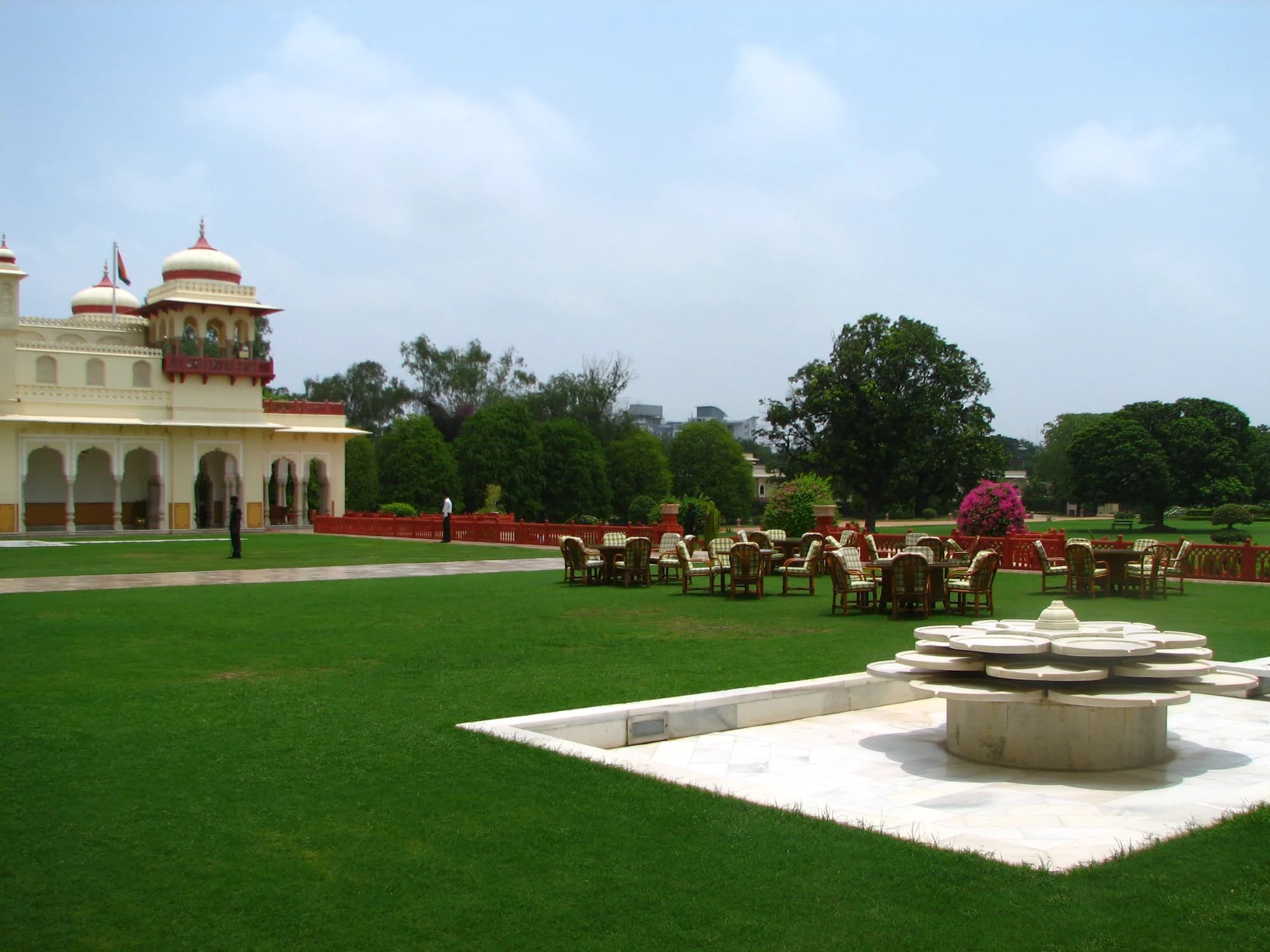
Rambagh Palace viewed from the Mughal Gardens at dawn — the ochre facade catching first light, peacocks crossing immaculate lawns, the Aravalli Hills a soft silhouette on the horizon
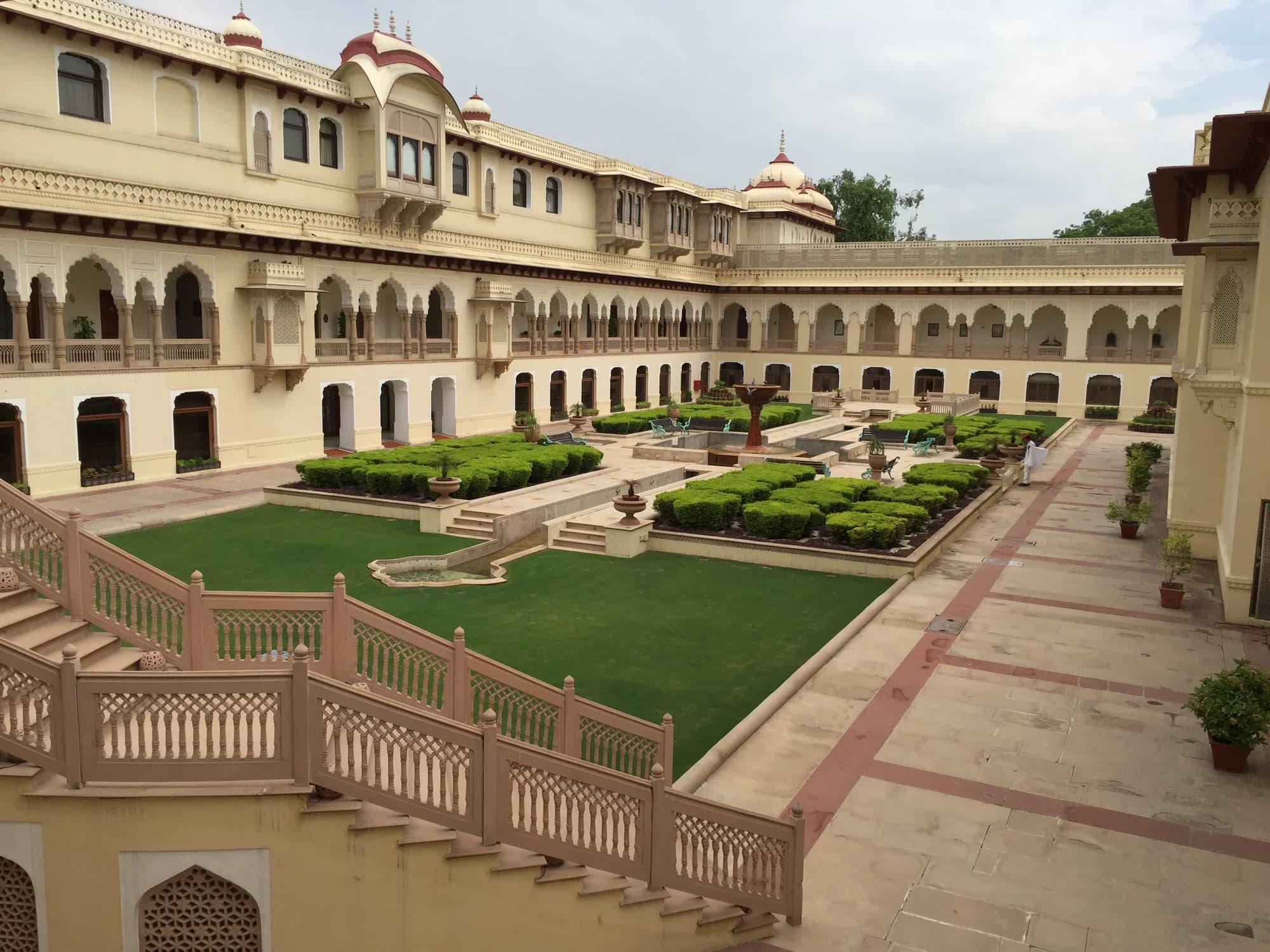
The palace's 47-acre estate was originally a modest garden house in 1835; it expanded over a century into the sprawling royal residence seen today, each wing reflecting the architectural ambitions of successive generations of Jaipur's rulers
The story begins in 1835, when the site was a modest garden house occupied by the wet nurse of Prince Ram Singh II. From that gentle origin, the property expanded over decades — through royal favour, architectural ambition, and eventually the vision of Maharaja Sawai Man Singh II, the last ruling Maharaja of Jaipur, and his legendary wife, Maharani Gayatri Devi. It was Gayatri Devi, one of the most photographed and celebrated women of the twentieth century, who transformed Rambagh from a royal guesthouse into the family's principal residence, and in doing so imbued its rooms with a style that remains the palace's defining quality: a fusion of Rajput formality and international sophistication.
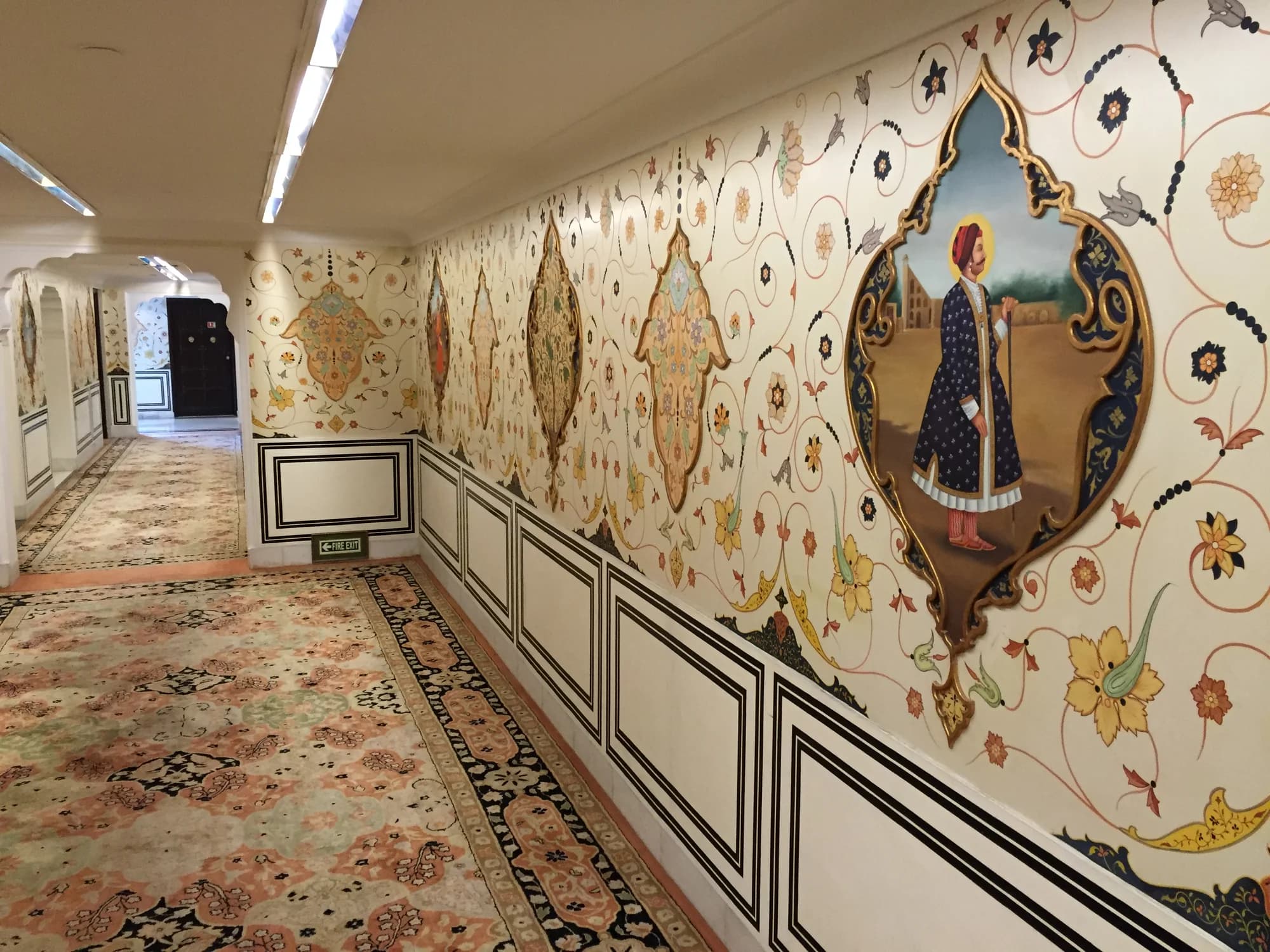
The central durbar hall at Rambagh Palace — crystal chandeliers, gilded mirrors, and a ceiling that took artisans fourteen years to complete, every square inch covered in hand-painted floral motifs in gold leaf
The durbar hall, where the Maharaja held court, remains the palace's most architecturally significant interior — its frescoed ceiling is considered among the finest examples of Rajasthani decorative painting from the early twentieth century
The Gayatri Devi Touch
Maharani Gayatri Devi was not merely the resident of Rambagh Palace. She was its animating spirit. Educated in London and at home in the drawing rooms of Europe, she brought to Rambagh an aesthetic that was simultaneously deeply Rajasthani and effortlessly cosmopolitan. She entertained heads of state, Hollywood royalty, and the international aristocracy in rooms that felt less like a formal palace and more like the world's most elegant private home — which, of course, is precisely what it was.
Her personal sitting room, now the Palace's signature suite, retains the atmosphere of her presence: French windows opening onto private gardens, a writing desk positioned to catch the morning light, walls in shades of ivory and pale rose. Photographs of her — at Ascot, at Buckingham Palace, at Rambagh hosting Jacqueline Kennedy — line the corridors, and the effect is not of a museum but of a family album left open for guests to browse.
“Jaipur is not a place you visit. It is a place that visits you, and never quite leaves.”
The Architecture of Arrival
The approach to Rambagh is a sequence designed to separate you from whatever world you arrived from. You turn off Bhawani Singh Road through gates of wrought iron and immediately the noise of Jaipur — the autorickshaws, the bicycle bells, the ceaseless percussion of urban India — drops away. A driveway lined with palms and manicured hedgerows curves past the polo ground where the Maharaja's horses still exercise each morning. The palace reveals itself not all at once but in layers: first the Mughal Gardens, then the ochre facade, then the central dome, then the sweep of colonnaded verandahs that wrap around the building like arms extended in welcome.
A doorman in a cobalt-blue turban — the colour of the Jaipur royal house — opens your car door. A garland of tuberoses, the fragrance heady and sweet, is draped around your neck. A silver tray appears bearing a welcome drink that changes with the seasons: chilled khus (vetiver) sherbet in summer, spiced almond milk in winter. Your luggage has already disappeared, and you will not think of it again until you find it, unpacked, in your suite.
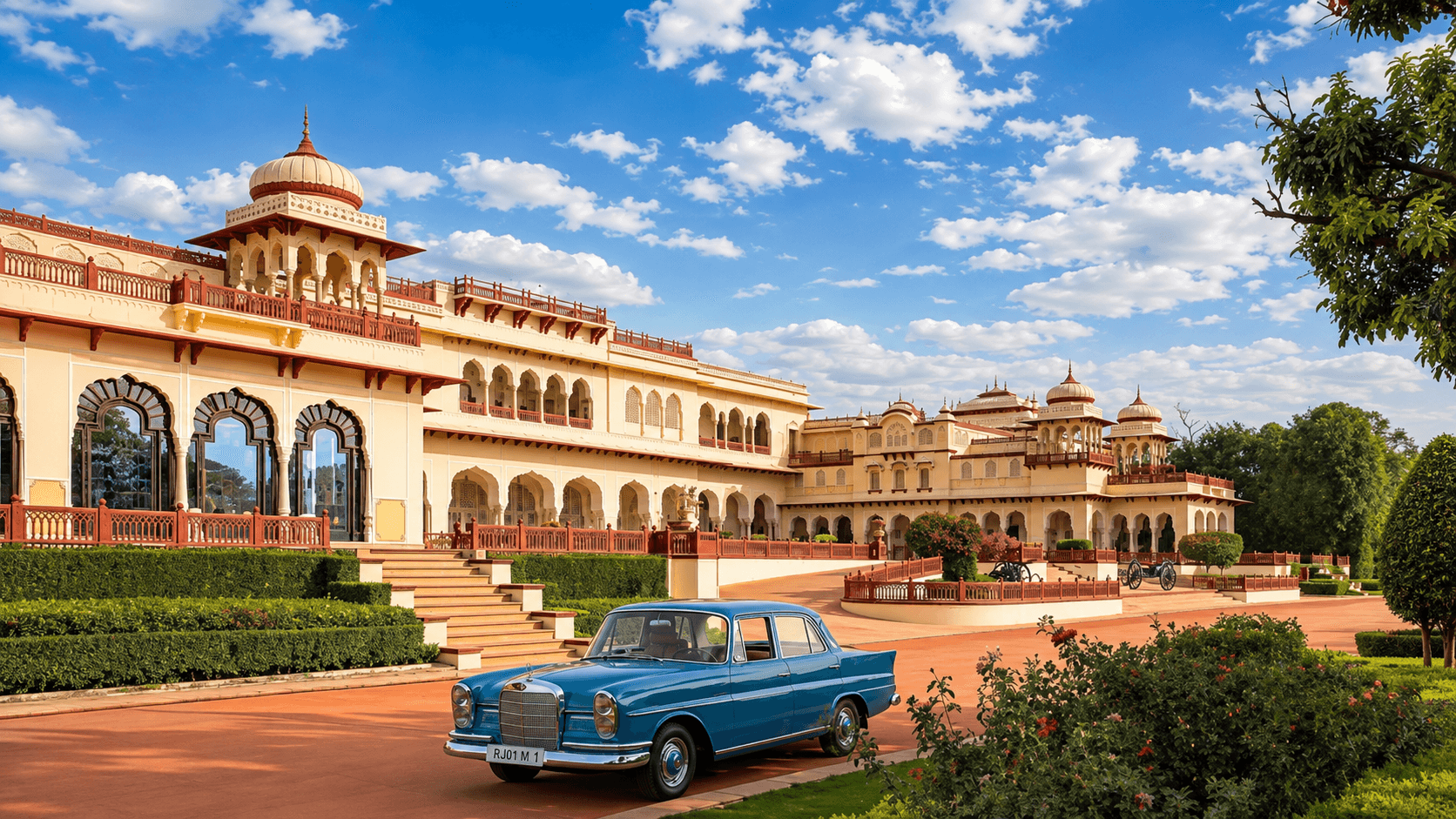
The front porch arrival at Rambagh Palace — liveried staff in cobalt-blue turbans, tuberose garlands, a vintage Bentley permanently stationed beneath the porte-cochère as a tribute to the Maharaja's automotive passion
The cobalt-blue turban is the livery colour of the Jaipur royal house, worn by every member of staff as a visible link to the palace's continuing identity as a royal residence
The Suites: A Taxonomy of Luxury
Rambagh offers seventy-eight rooms and suites, but the number tells you nothing useful. The useful information is this: every room category at Rambagh is approximately twice as good as its equivalent at a standard luxury hotel. The entry-level Palace Rooms, at roughly 45 square metres, feature fourteen-foot ceilings, hand-painted frescoes, and bathrooms of white Makrana marble — the same marble that clads the Taj Mahal. The furniture is not reproduction. It is original, commissioned by the royal family in the 1930s and 1940s from master craftsmen in Jaipur and Shekhawati.
The Royal Suites occupy the palace's most historically significant spaces. The Suryavanshi Suite, named for the solar dynasty from which the Jaipur royal family claims descent, opens onto a private terrace with uninterrupted views of the Mughal Gardens and the Aravalli Hills beyond. The interior is a masterclass in Rajasthani decorative arts: frescoed ceilings, carved sandstone jalis, a four-poster bed that required three years of work by a single master carpenter. The bathroom, panelled in Italian marble, features a bathtub large enough for two — a detail that seems to have been a particular preoccupation of the Maharani's interior design brief.
The Suryavanshi Suite bedroom — a carved four-poster bed beneath frescoed ceilings, French windows opening onto a private terrace with uninterrupted views of the Mughal Gardens
The four-poster bed, carved from Indian rosewood by a single master craftsman over three years, bears the solar motif of the Suryavanshi dynasty in its headboard — a detail repeated throughout the suite's furnishings
The Sujan Rajmahal Suite, the palace's largest and most expensive accommodation, is essentially a private residence within the palace complex. It occupies a corner of the building with views in three directions, includes a private dining room seating eight, a study lined with books from the royal library, and a master bedroom whose bed — an enormous carved teak confection crowned with the Jaipur coat of arms — has hosted, among others, Prince Charles, Bill Clinton, and Oprah Winfrey. The suite's private butler, a gentleman who has served at Rambagh for over thirty years, can arrange experiences that do not appear on any menu: a private puja ceremony at dawn in the palace temple, an audience with the current Maharaja at the City Palace, a round of golf on the palace's private nine-hole course.
The Table at Rambagh
Dining at Rambagh is an exercise in understanding that Rajasthani cuisine, properly executed, belongs in the pantheon of the world's great culinary traditions. The palace's kitchens are custodians of recipes that have been passed down through the royal family for centuries, and the chefs — many of whom are descendants of the royal khansamas (cooks) — approach their work with the seriousness of culinary historians.
Suvarna Mahal, the palace's formal dining room, occupies the former state banquet hall. The room itself is a monument: 18th-century frescoes cover every surface, a gold-leaf ceiling glows forty feet overhead, and chandeliers of Bohemian crystal cast a warm amber light across tables set with crested silver and monogrammed china. The menu is a deliberate celebration of royal Rajasthani cooking: dishes that were once served exclusively to the Maharaja and his guests, now available to anyone with a reservation and the inclination to dress for dinner.
The signature dish — and it deserves that overused designation — is the Dal Rambagh. It is, at first glance, a simple black lentil preparation. But the lentils have been simmered for thirty-six hours with ghee, cream, and precisely twenty-seven spices in proportions known only to the palace's executive chef. The result is a dish of extraordinary depth: smoky, creamy, complex, and utterly unlike the dal served anywhere else in India. Jacqueline Kennedy, during her 1962 visit, is said to have requested it for three consecutive meals.
Suvarna Mahal restaurant — candlelit tables beneath 18th-century frescoes, crested silverware catching the light of Bohemian crystal chandeliers, the atmosphere of a state banquet rendered intimate
The restaurant occupies the former state banquet hall where Maharaja Sawai Man Singh II entertained visiting heads of state; the frescoes, executed by court painters, depict scenes from the Hindu epics in the distinctive Jaipur school miniature style
For lunch, the Verandah — the palace's colonnaded outdoor restaurant — offers a lighter menu with views of the gardens that require no culinary accompaniment to justify a two-hour meal. The Rajasthani thali here is the most comprehensive introduction to the region's cooking available in Jaipur. It includes fifteen dishes, each prepared to the standard of Suvarna Mahal but served in the gentle chaos of a traditional Indian meal: small bowls arriving in rapid succession, a waiter hovering attentively to explain each dish, the gardens providing a backdrop of emerald green and flowering bougainvillea.
Steam, the palace's restored vintage train carriage, sits on the lawns and serves Continental breakfast and afternoon tea. The carriage, a 1920s Parlor Car that once transported the Maharaja between Jaipur and Delhi, has been meticulously restored with its original marquetry, brass fittings, and plush velvet upholstery intact. Afternoon tea here — Darjeeling first flush, finger sandwiches, scones with clotted cream and rose petal jam — is one of Jaipur's essential experiences, and the carriage's diminutive size (it seats only twenty-four) ensures an intimacy that feels distinctly un-hotel-like.
The Experiences
Rambagh's location, at the geographical and cultural heart of Jaipur, makes it an ideal base for exploring the Pink City. But the palace itself offers a program of experiences that could easily fill three days without ever leaving the grounds.
The palace's Jiva Spa, located in the former royal spa quarters, draws on Ayurvedic traditions that were practiced exclusively for the royal family for centuries. The signature treatment, the Jivaniya Ritual, is a four-hour sequence of abhyanga (warm oil massage), shirodhara (a steady stream of warm oil poured onto the forehead), and a herbal wrap, followed by a rose-petal bath in a marble tub overlooking a private courtyard. It is, without exaggeration, one of the finest spa experiences available anywhere in Asia.
The palace's vintage carriage rides, offered each evening at sunset, are a more active indulgence. A restored Victorian landau, drawn by two Marwari horses, takes guests on a circuit of the palace grounds while a guide narrates the history of the estate — the polo ground where the Maharaja's team won three consecutive national championships, the Mughal Gardens planted by Gayatri Devi herself, the private temple where the family's morning puja has been performed every day for two hundred years.
Sunset carriage ride at Rambagh Palace — a restored Victorian landau drawn by Marwari horses, champagne flutes catching the golden light, the Aravalli Hills blushing rose in the distance
The Marwari horses, with their distinctive inward-curving ears, are a breed native to the Marwar region and were the preferred mounts of Rajput cavalry for centuries
For the more actively inclined, the palace can arrange a game of polo on the Maharaja's private ground, complete with instruction from a member of the royal stables and the loan of a polo pony. The experience is not cheap — ₹75,000 ($900) for a morning session — but it is a genuine privilege, as the ground is normally closed to all but the royal family and their invited guests.
The palace also offers a private tour of the City Palace, the administrative seat of the Jaipur royal family, located fifteen minutes from Rambagh. This is not the standard tourist visit. Your guide is a member of the royal household, and doors that are closed to the public swing open at his approach: the private armory, the royal wardrobes (featuring garments worn by Maharaja Sawai Madho Singh I who, at 250 kilograms, was one of the largest men ever to sit on a throne), and the Chandra Mahal, where the current Maharaja still resides. The experience concludes with high tea in a private salon overlooking the palace courtyards.
Insider Tips
Best Time to Book
Rambagh is busiest from October to March, with December and January being the peak months when suites can sell out six months ahead. For better availability and rates, consider October (just after the monsoon, when Jaipur is freshly green) or late February to early March (spring, with pleasant temperatures and flowering gardens). July and August bring the monsoon — dramatic skies, few tourists, and rates reduced by up to 35 percent. The palace is gorgeous in the rain.
Suite Strategy
The Palace Rooms offer exceptional value for a property of this calibre. If you are upgrading, the Royal Suites in the original palace wing are preferable to those in the newer wing — the original wing has higher ceilings, more elaborate frescoes, and a palpable sense of history. Avoid rooms facing the main road (Bhawani Singh Road), where occasional traffic noise can penetrate the palace's thick walls.
Dining Reservations
Book Suvarna Mahal at least one week in advance, particularly for weekend dinners during peak season. Request Table 7 — it occupies a private alcove with the best sightlines to the frescoed ceiling and the most attentive service position. For Steam, the vintage train carriage, book the 4:00 PM afternoon tea slot, which coincides with the golden hour light across the lawns.
Final Word
Rambagh Palace is not competing with other hotels in Jaipur. It is competing with a memory — the memory of what a royal household once was, and what hospitality once meant before the age of efficiency metrics and standardized service protocols. That it succeeds so completely is a testament not to its management (though the Taj group runs the property with quiet excellence) but to its lineage. This was not built as a hotel. It was built as a home, and it has never quite stopped feeling like one.
“Rambagh does not try to be the best hotel in Jaipur. It tries to be the best version of itself — a royal household that happens to accept reservations.”
You come to Rambagh not for a checklist of amenities but for an atmosphere that cannot be replicated: the scent of tuberoses in the lobby, the sound of peacocks on the lawn at dawn, the taste of a dal recipe that has been perfected over centuries, the sight of a sunset over the Aravalli Hills from a verandah that has witnessed a hundred years of such sunsets. You leave understanding that luxury, at its highest level, is not about what you are given. It is about what you are invited into.
Rambagh Palace at twilight — the ochre facade illuminated by hundreds of diyas (oil lamps), the Mughal Gardens in full bloom, peacocks roosting in ancient banyan trees, the palace glowing like a lantern against the deepening Rajasthani sky
Each evening, palace staff place hundreds of traditional oil lamps along the verandahs and garden paths — a ritual that transforms the already beautiful palace into something approaching the magical