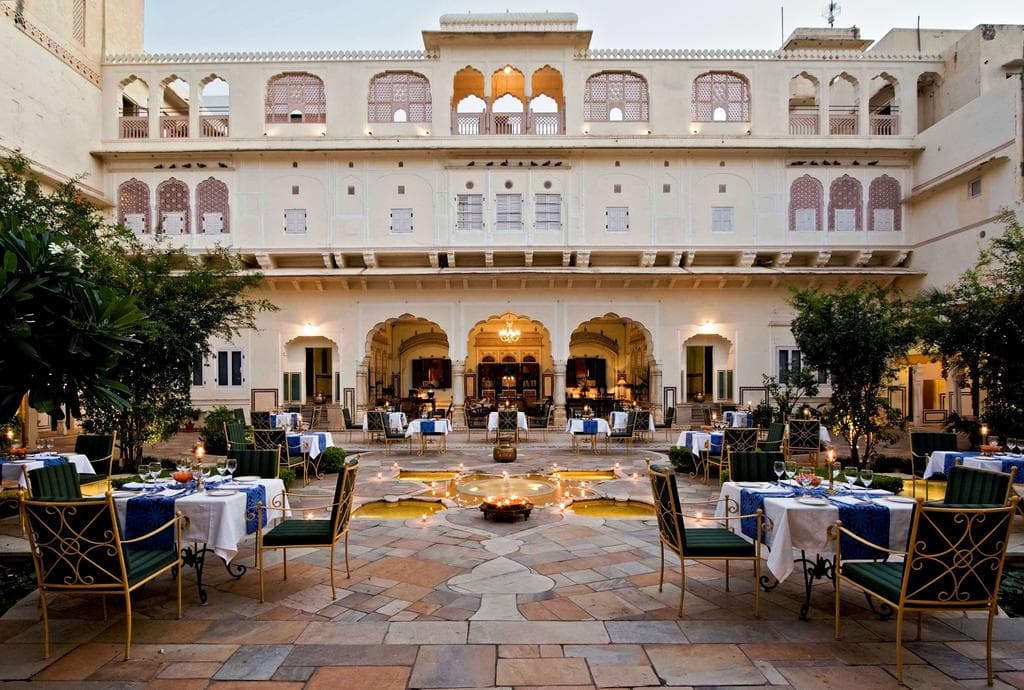
Samode Haveli is the city cousin of Samode Palace — a noble townhouse hidden within Jaipur's old city walls, its unassuming entrance on a narrow lane giving no indication of the oasis that lies within. Push past the heavy wooden door, and you enter a world of frescoed courtyards, Mughal gardens, and the unmistakable hush of a well-kept family secret. Where Samode Palace, forty kilometres to the north, offers hillside solitude, Samode Haveli offers the opposite: a tranquil refuge in the heart of the Pink City, a place where the chaos of Jaipur's bazaars — the autorickshaws, the camels, the jewellery shops and spice merchants — feels a world away, despite being five minutes on foot.
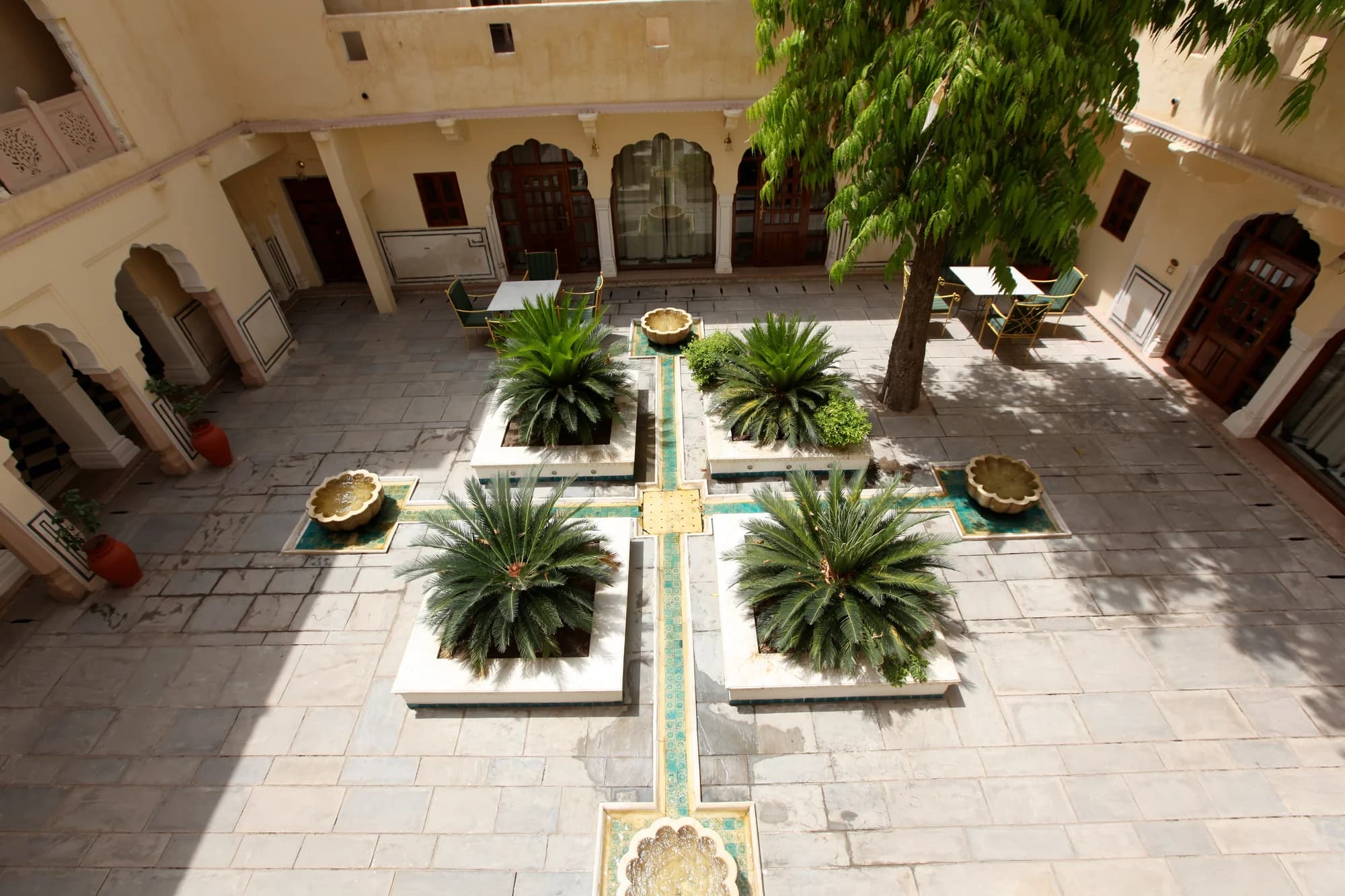
The inner courtyard of Samode Haveli — hand-painted frescoes in vegetable dyes covering every surface, their colours softened by two centuries of gentle Rajasthani sunlight, a fountain murmuring at the centre of the marble floor
The haveli was designed around a sequence of courtyards, each more private than the last — the outer courtyard for official visitors, the middle for family gatherings, the innermost zenana for the women of the household, the architecture itself a spatial translation of Rajput social hierarchy
Photo: Richard Moross, CC BY 2.0
The haveli, built in the nineteenth century and expanded over subsequent generations, was the Jaipur residence of the Rawals of Samode — the same noble family whose ancestral palace sits in the hills north of the city. Like all significant havelis in Rajasthan, it was designed around a sequence of courtyards, each one more private than the last, the architecture a spatial translation of Rajput social hierarchy. The outer courtyard received visitors on official business; the middle courtyard was for family gatherings and celebrations; the innermost courtyard, the zenana, was the domain of the women of the household. Today, the entire property functions as a hotel, but the courtyard hierarchy remains legible, and the sense of moving through layers of privacy — of being a guest in a family home rather than a customer in a commercial establishment — is Samode Haveli's defining quality.
The Elephant Ramp and the Frescoes
The haveli's most distinctive architectural feature is its elephant ramp — the haathi pol — a gently sloping stone passageway that allowed the Rawal's elephants to ascend to the upper courtyard for ceremonial occasions. Elephants were not merely transport in Rajput India; they were instruments of state pageantry, their painted foreheads and jewelled howdahs conveying power more effectively than any written proclamation. The ramp at Samode Haveli is one of the few surviving examples in Jaipur, and its graceful curve, rising between frescoed walls, is a monument to a vanished era of Rajasthani spectacle.
The frescoes that cover the courtyard walls are the haveli's other great treasure. Painted with the same vegetable dyes — ground lapis lazuli for blue, terra verte for green, iron oxide for red — that the Rawals' artists used at Samode Palace, they depict floral arabesques, mythological scenes, and the recurring motif of elephants in procession, their mahouts holding aloft the standards of the Samode family. The colours have faded with time into a gentle, chalky palette that the midday sun flattens but the low light of early morning or late afternoon renders with extraordinary depth. Photograph them at dawn, when the first light strikes the eastern wall and the courtyard is empty of all but the resident pigeons.
The elephant ramp (haathi pol) at Samode Haveli — the gently sloping stone passageway where the Rawal's ceremonial elephants once ascended, frescoed walls on either side, the morning light catching the faded vegetable-dye colours
Elephants were instruments of state pageantry in Rajput India — their painted foreheads and jewelled howdahs conveying power more effectively than any written proclamation — and this is one of the few surviving elephant ramps in Jaipur
The Rooms: Heritage With Comfort
The 39 rooms and suites at Samode Haveli spread across the property's various wings, and the quality varies significantly. The best rooms — the suites in the original haveli building — feature frescoed walls, high ceilings with carved wooden beams, and windows overlooking the garden courtyard. They are furnished with antiques from the family's collection: carved wooden chests, miniature paintings, hand-knotted durries in the traditional geometries of Rajasthan. The bathrooms are modern, with rainfall showers and, in the higher-category suites, deep soaking tubs set into alcoves that were once the private bathing chambers of the Samode household.
The garden wing rooms are more contemporary in feeling — comfortable, well-appointed, and lacking the frescoed character of the original building. They are worth considering if the haveli rooms are full or if you prefer a more standardised hotel experience. But the point of staying at Samode Haveli is the heritage, and the heritage rooms, for all their charming irregularities (a door that sticks, a floor that slopes gently, a window that frames a view unchanged in two centuries), are the reason to be here.
A suite in the original haveli building — frescoed walls in dusty rose and faded indigo, carved wooden ceiling beams, antique furniture from the Samode family collection, French windows opening onto a private balcony above the garden courtyard
The best rooms feature frescoed walls, high ceilings with carved wooden beams, and windows overlooking the garden courtyard — they are furnished with carved wooden chests, miniature paintings, and hand-knotted durries in traditional Rajasthani geometries
“To stay at Samode Haveli is to understand what Jaipur was before it became a tourist destination — a city of noble families, hidden courtyards, and the quiet, enduring beauty of well-kept secrets.”
Dining: Rajasthani Tradition in a Garden Courtyard
The haveli's restaurant occupies the former dining hall of the Rawals, opening onto a garden courtyard of bougainvillea, frangipani, and a central fountain. The menu offers both Rajasthani and Continental options, but ordering the Continental at a property whose owners have been refining their Rajasthani cuisine for two centuries seems like missing the point. The kitchen prepares a Laal Maas of considerable depth — the Mathania chillies creating a slow-building heat that lingers rather than assaults — and a safed maas of surpassing delicacy, the lamb cooked in a yoghurt-and-almond gravy until it falls apart beneath a spoon.
The thali, as at Samode Palace, is the most comprehensive introduction to the cuisine. Served on a silver platter with a dozen dishes, it changes daily based on what is fresh and what the cooks feel like preparing. You might encounter Ker Sangri, the desert bean preparation that is Rajasthan's most distinctive vegetable dish; Gatte ki Sabzi, gram flour dumplings simmered in a spiced yoghurt gravy; Bajre ki Roti, the dense, nutty millet bread that is the staple of rural Rajasthani diets; and, in season, the wild game dishes that are a Samode family speciality.
Dinner is often served by candlelight, the courtyard illuminated by lanterns hung from the branches of the neem tree that dominates the garden. In the cooler months, a fire is lit in the central brazier, and guests linger over cups of masala chai or glasses of single malt until the stars are bright overhead and the city's noise has faded to a distant murmur.
The Pool and Gardens
The haveli's swimming pool, set into a terrace above the garden courtyard, is a modest rectangle of turquoise water surrounded by loungers and shaded by neem trees. It is not the infinity-edge spectacle of a resort pool, but it serves its purpose — a respite from the Jaipur heat, a place to read a book and order a lime soda and listen to the peacocks calling from the rooftops. The gardens, laid out in the Mughal style with geometric flower beds and a central water channel, are a pleasant place for an evening stroll, though their scale is more domestic than palatial.
Navigating Jaipur from Samode Haveli
The haveli's location in the old city is both its greatest asset and its greatest challenge. You are within walking distance of the Hawa Mahal, the City Palace, Jantar Mantar, and the bazaars of Johari and Bapu. But Jaipur's old city is intense — the traffic, the noise, the insistent salesmanship of the bazaar. Use the haveli as a base: venture out for a few hours in the morning, return for lunch and a siesta by the pool, and emerge again in the late afternoon when the light is golden and the city's energy has softened. The haveli can arrange a car and driver by the day or by the half-day, and having a reliable, air-conditioned vehicle in Jaipur is worth every rupee.
Room Strategy
Book a suite in the original haveli building. The garden wing rooms are perfectly adequate, but you did not travel to Jaipur for perfectly adequate. The frescoed suites on the upper floor are the pick — they offer the most privacy and the best light. Avoid rooms directly above the kitchen or the service areas, which can be noisy in the early morning.
Frequently Asked Questions
How does Samode Haveli compare to Rambagh Palace? They are different in scale, price, and character. Rambagh Palace is one of the world's great palace hotels — grand, formal, and priced accordingly. Samode Haveli is smaller, more intimate, and significantly less expensive, with a family-home atmosphere that Rambagh, for all its splendour, cannot replicate. If your budget permits both, they complement each other well: Rambagh for the palace hotel experience, Samode Haveli for the old-city immersion.
Is it safe to walk in the old city at night? The immediate area around the haveli is quiet after dark, and walking to nearby restaurants is generally safe, though solo female travellers may prefer a taxi or autorickshaw for anything beyond a few blocks. The haveli's staff are an excellent source of advice on where to go and how to get there.
What is the dress code? Casual during the day, smart casual in the evening. Jaipur is conservative by the standards of Indian cities; shoulders and knees should be covered when visiting temples or walking through the old city.
How many nights should I stay? Two to three nights provides time to see the major Jaipur sights — the Amber Fort, the City Palace, Jantar Mantar, Hawa Mahal — while also enjoying the haveli's quieter rhythms. If Jaipur is your first stop in India, a third night allows for recovery from jet lag and a more leisurely exploration of the city.
Samode Haveli at dusk — the neem tree spreading its branches over the garden courtyard, lanterns beginning to glow in the arcades, the frescoed walls catching the last light, the Pink City settling into evening quiet beyond the ancient walls
To stay at Samode Haveli is to understand what Jaipur was before it became a tourist destination — a city of noble families, hidden courtyards, and the quiet, enduring beauty of well-kept secrets