Hanoi is the most elegant city in Southeast Asia. Ho Chi Minh City, its southern rival, is more dynamic. Bangkok is grander. Singapore is cleaner and richer. But Hanoi, with its emerald lakes, its French colonial villas slowly surrendering to the tropical humidity, its temple bells drifting across the water at dawn, possesses an atmosphere that none of them can replicate. It is a city that has absorbed a thousand years of Chinese domination, a century of French colonialism, and the devastation of the American War, and somehow emerged with its identity not merely intact but burnished — the same temple incense, the same pho stalls, the same old men playing xiangqi on the pavements, the same patience with history that only a city founded in AD 1010 could possess.

/images/experiences/26-hanoi/img-01.webp
Hoan Kiem — "Lake of the Returned Sword" — takes its name from a 15th-century legend in which the emperor Le Loi, after defeating Chinese Ming invaders with a magical sword given to him by the Dragon King, was boating on the lake when a giant golden turtle surfaced, seized the sword, and returned it to its divine owner. The Huc Bridge, its name meaning "morning sunlight," was built in 1865 and painted in the brilliant vermilion that symbolises luck and prosperity in Vietnamese culture. Ngoc Son Temple on the islet at the bridge's far end, dedicated to the Confucian scholar Van Xuong and the military hero Tran Hung Dao, dates to the 18th century and contains a preserved specimen of a giant softshell turtle — the last of the species that once inhabited the lake and were believed to be the Dragon King's emissaries.
Photo: Photo courtesy of Vietnam National Administration of Tourism
The city's geography is a gift. Hanoi is built around lakes — Hoan Kiem in the centre, West Lake and Truc Bach Lake in the north, Bay Mau Lake and a dozen smaller bodies of water scattered through the districts. The lakes are the city's lungs, its refrigerators, its spiritual centres. Around them, the neighbourhoods of the Old Quarter — the 36 Streets, each one named for the guild that once plied its trade there — form a dense grid of commerce, cuisine, and centuries-old architecture that rewards the attentive wanderer. Venture anywhere on foot. The best thing you see in Hanoi will almost certainly be something you were not looking for.
The Old Quarter: A Thousand Years in Thirty-Six Streets
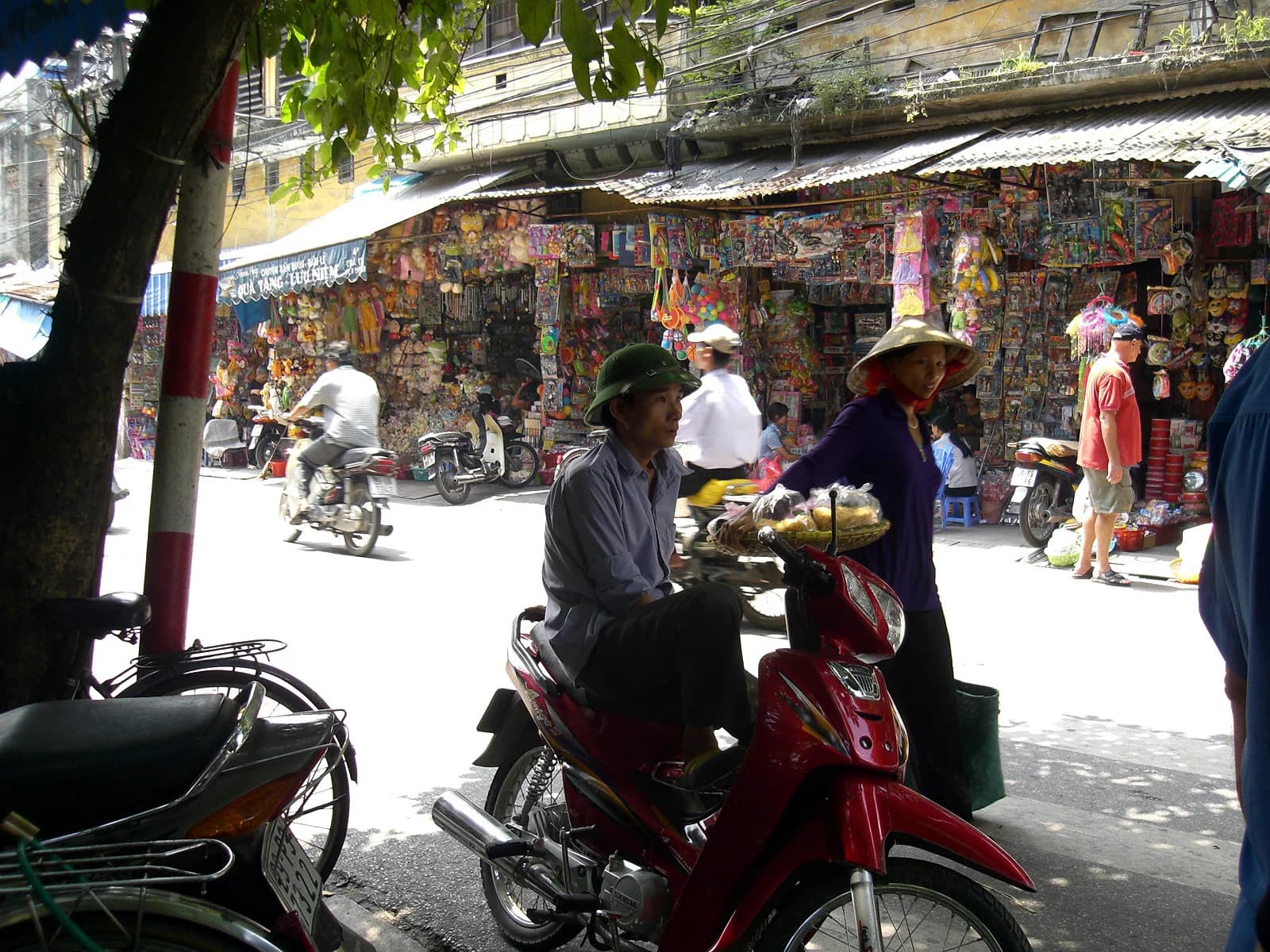
The Old Quarter is Hanoi's historical and commercial heart, a dense grid of streets that has been in continuous operation since the city's founding. Each street was traditionally dedicated to a single trade — Hang Bac (Silver Street), Hang Gai (Silk Street), Hang Quat (Fan Street), and the wonderfully specific Hang Thiec (Tin Street) and Hang Non (Conical Hat Street). The guild system has long since dissolved, but the streets retain the names and, in many cases, the businesses: Hang Ma still sells paper votive offerings for temple ceremonies, Hang Bac still has silversmiths, and the hardware merchants of Lo Ren still trade in the tools of their forefathers' trade.
Walking the Old Quarter is Hanoi's essential experience, and it requires a strategy. Do not attempt to "see" it — the streets are too dense, too repetitive, too exhausting for that approach. Instead, choose a theme for each walk: the food streets around Hang Buom and Ma May, the silk shops of Hang Gai and its tributaries, the temple alleys where small shrines hide behind unmarked doors. Stop frequently — for a glass of bia hoi (fresh beer, brewed daily and consumed within hours, the cheapest beer in the world at approximately twenty-five US cents a glass), for a bowl of bun cha (grilled pork with vermicelli, the dish that Barack Obama and Anthony Bourdain shared on the world's most famous diplomatic dinner), for an egg coffee at a café overlooking the street. The Old Quarter is not a checklist. It is a mood.

/images/experiences/26-hanoi/img-02.webp
Hanoi's Old Quarter — the 36 Streets — dates to the city's founding in AD 1010 by Emperor Ly Thai To, who recognised the strategic location between the Red River and Hoan Kiem Lake. Each street was historically settled by a single craft guild from the surrounding villages, and the architecture — narrow frontages, deep interior spaces, internal courtyards open to the sky — reflects a medieval building tax calculated on street-facing width rather than total area. The tube houses that dominate the quarter, some dating to the 17th century, survive through a combination of UNESCO-supported conservation efforts and the fierce determination of the families who have lived and traded here for generations.
Photo: Photo courtesy of Vietnam National Administration of Tourism
Pho: Vietnam in a Bowl
Pho is not merely Vietnam's national dish. It is a cultural artefact, a culinary argument, and a source of intense regional pride. Hanoi pho — pho bac — is the original: a clear, amber beef broth, flat rice noodles, thinly sliced beef, and a garnish of fresh herbs, chilli, and lime that the diner adds at the table. It is simpler, purer, and — Hanoians will tell you with absolute certainty — superior to the sweeter, more heavily garnished pho of the south, which was corrupted by the influence of Saigon's Chinese community and the easy availability of sugar.
The classic Hanoi pho experience begins before dawn, at a street stall where the proprietor — often a woman in her sixties or seventies who has been making the same broth for forty years — serves the first bowls to the city's early risers. The broth is the result of hours of simmering: beef bones, charred ginger, star anise, cinnamon, cardamom, and the closely guarded secrets that distinguish one pho stall from another. The noodles are fresh, the beef is sliced razor-thin, and the experience — sitting on a low plastic stool on a pavement, a steaming bowl cradled in your hands, the city stirring to life around you — is a Hanoi morning ritual that no hotel breakfast buffet can replicate.
The city's most famous pho establishments are institutions: Pho Gia Truyen on Bat Dan Street, whose queue stretches down the block from the moment it opens; Pho Thin on Lo Duc, where the beef is stir-fried in garlic before being added to the broth; Pho Suong on Trung Yen Alley, where the broth has a clarity that borders on the spiritual. Each one is different. Each one is worth the journey.

/images/experiences/26-hanoi/img-03.webp
Pho emerged in the early 20th century in Nam Dinh province south of Hanoi, a hybrid of French colonial demand for beef (cattle were traditionally draught animals, not food) and Vietnamese noodle-soup traditions influenced by Chinese cooking techniques. The definitive Hanoi-style pho — pho bac — is characterised by a broth of extraordinary clarity, achieved through hours of careful simmering and the systematic skimming of impurities, seasoned only with charred ginger, star anise, cinnamon, and fish sauce. The accompanying plate of fresh herbs — Thai basil, culantro, mint, and the essential lime wedge — arrives separately, allowing each diner to calibrate the balance of aromatic freshness to their own taste.
Photo: Photo courtesy of Vietnam National Administration of Tourism
“Hanoi is the only city I know where the past feels not like a memory but like a presence — a friendly ghost who sits beside you at the pho stall and orders a second bowl.”
The French Quarter: Colonial Grandeur, Tropical Decay
South of Hoan Kiem Lake, the streets widen and the architecture shifts from Vietnamese shop houses to French colonial mansions. The French Quarter, built during the colonial era (1887-1954) as the administrative and residential centre of French Indochina, is a landscape of ochre-washed villas, wrought-iron balconies, and tree-lined boulevards that could, in certain lights, be mistaken for a tropical version of Provence — if not for the motorbikes, the pho stalls, and the unmistakable energy of a Vietnamese city.
The Opera House, built in 1911 and modelled on the Palais Garnier in Paris, is the French Quarter's architectural centrepiece — a neoclassical pile of marble staircases, gilded balconies, and a performance schedule that includes Vietnamese opera, ballet, and the occasional touring symphony orchestra. The building survived the wars that destroyed much of Hanoi's colonial fabric, and its grandeur — slightly faded, defiantly elegant — is a reminder of the complex legacy that French colonialism left in Indochina.
The Sofitel Legend Metropole, on Ngo Quyen Street, has been Hanoi's finest hotel since 1901, when it opened as the Grand Métropole. Its guest book is a twentieth-century who's-who: Graham Greene, Somerset Maugham, Charlie Chaplin, and, during the American War, the foreign correspondents who covered the conflict from Hanoi. The hotel's bomb shelter, discovered during renovations in 2011 and now open for guided tours, is a chillingly intimate reminder of the war that defined a generation. The Bamboo Bar, by contrast, is a reminder of the colonial-era luxury that the Metropole has always provided: ceiling fans, rattan furniture, gin and tonics served with a slice of lime, and the sense, once the first sip is taken, that the twenty-first century has been politely asked to wait outside.
The Temple of Literature: Vietnam's First University
The Temple of Literature, founded in 1070 and dedicated to Confucius, is Hanoi's most important historical site. For over 700 years, it housed the Imperial Academy — Vietnam's first university, where the sons of the elite were educated in the Confucian classics, poetry, and administration. The temple is a sequence of five courtyards, each one more serene than the last, culminating in the Well of Heavenly Clarity and the Stelae of Doctors — 82 stone turtles bearing stelae inscribed with the names of the scholars who passed the imperial examinations between 1442 and 1779.
The symbolism is deliberate: the turtle, in Vietnamese cosmology, represents longevity and wisdom, and the scholars whose names are carved here were the intellectual aristocracy of pre-modern Vietnam. The temple remains a place of pilgrimage for Vietnamese students, who come before their university entrance exams to pray for success — a tradition that has persisted, unchanged in its essentials, since the fifteenth century. The gardens, planted with frangipani and ancient banyan trees, are an oasis of quiet in a city that rarely stops to whisper.

/images/experiences/26-hanoi/img-04.webp
Founded in 1070 by Emperor Ly Thanh Tong and dedicated to Confucius, the Temple of Literature housed the Imperial Academy — Vietnam's first university — for over 700 years. The 82 stone stelae, each mounted on a carved turtle pedestal, record the names and accomplishments of the scholars who passed the royal examinations between 1442 and 1779 — a total of 1,307 graduates whose intellectual achievements were literally carved in stone for posterity. The turtles, in Vietnamese cosmology, represent longevity and the foundation of the earth, and the stelae were recognised by UNESCO in 2010 as part of the Memory of the World Programme, a rare honour that acknowledges their significance as documentary heritage of global importance.
Photo: Photo courtesy of Vietnam National Administration of Tourism
The Coffee Culture: Egg Yolks and Condensed Milk
Vietnam is the world's second-largest coffee producer, and Hanoi's coffee culture is a distinctive fusion of French colonial influence and Vietnamese improvisation. The classic Vietnamese coffee — ca phe sua da — is a glass of strong, dark-roast robusta, brewed through a small metal filter (phin) and mixed with sweetened condensed milk, served over ice. It is sweet, potent, and entirely addictive, and it fuels the city from dawn until well past midnight.
The egg coffee — ca phe trung — is Hanoi's unique contribution to world caffeine culture, invented in the 1940s when fresh milk was scarce and a creative bartender at the Giang Café substituted whisked egg yolk and condensed milk. The result — a creamy, meringue-like foam floating atop a shot of dark coffee — tastes like tiramisu in liquid form and is best consumed at its birthplace, Café Giang, a small establishment on Nguyen Huu Huan Street that has been serving the same recipe for over seventy years.
The coffee culture of Hanoi extends far beyond these signature drinks. The city's café scene is a parallel universe — a network of small, often hidden establishments where the coffee is excellent, the soundtrack is jazz or classical, and the Vietnamese tradition of slow, contemplative café society is observed with a seriousness that borders on religion. Tranquil Books & Coffee, hidden above a shop in the Old Quarter, serves pour-over single-origin arabica in a room of books, plants, and classical music. Note Coffee, on a balcony overlooking Hoan Kiem Lake, serves egg coffee and smoothie bowls with a view that justifies the steep staircase.

/images/experiences/26-hanoi/img-05.webp
Ca phe trung was invented in 1946 by Nguyen Van Giang, a bartender at the Sofitel Legend Metropole who, faced with the post-war scarcity of fresh milk in French Indochina, substituted whisked egg yolk and sweetened condensed milk as a creamer for the strong robusta coffee his Vietnamese customers preferred. The egg yolk is beaten with condensed milk and vanilla to a meringue-like consistency, achieving a texture that resembles liquid tiramisu — rich, airy, and supported by the dark, intense coffee beneath. Café Giang, which Giang's son now runs, occupies the same small storefront on Nguyen Huu Huan Street, and the phin filter — a French colonial adaptation of the Indian filter that slow-drips individual cups — remains the only brewing method.
Photo: Photo courtesy of Vietnam National Administration of Tourism
Crossing the Street
Hanoi's traffic is a perpetual river of motorbikes, and crossing the street is an act of faith. The rule: step off the curb and walk at a steady, predictable pace. Do not stop. Do not run. Do not attempt to dodge the motorbikes, which will weave around you with a margin of error that feels terrifyingly small but is, statistically, sufficient. The motorbikes are not trying to hit you. They are simply navigating a city without traffic lights, and your steady pace helps them calculate their trajectory. After a day, you will find it exhilarating. After a week, you will wonder why the rest of the world bothers with pedestrian crossings.
Frequently Asked Questions
When is the best time to visit Hanoi? October through December and March through April offer the most pleasant weather — warm but not hot, with low humidity and clear skies. January and February can be surprisingly cold (temperatures occasionally drop below 10°C) and grey. May through September is hot, humid, and punctuated by monsoon downpours, but the rain clears quickly and the dramatic skies are a photographer's dream.
How many days do I need? Four full days is the minimum for a satisfying introduction: one for the Old Quarter and Hoan Kiem Lake, one for the French Quarter and the museums (the Vietnam Museum of Ethnology and the Vietnamese Women's Museum are both world-class), one for the Temple of Literature, West Lake, and the Ho Chi Minh Mausoleum complex, and one for a culinary deep-dive — pho, bun cha, banh cuon, cha ca, and the city's remarkable street-food culture.
Is Hanoi safe? Yes — violent crime against tourists is extremely rare. Pickpocketing and phone-snatching from motorbikes are the main risks; keep your phone in your pocket or bag when near the street, and carry bags on the side away from the road. The traffic is the greatest danger — crossing the street requires the technique described above.
How does Hanoi compare to Ho Chi Minh City? Hanoi is the cultural and political capital, cooler in climate and temperament, more traditional, more literary, more reserved. Ho Chi Minh City is the economic engine, warmer, louder, more entrepreneurial, more of a party. The food in Hanoi is subtler and more herbaceous; the food in HCMC is sweeter and bolder. The rivalry is real, the differences are instructive, and the ideal Vietnam journey includes both.
What should I eat? Pho (beef noodle soup), bun cha (grilled pork with vermicelli — Obama and Bourdain ate it, and so should you), banh cuon (steamed rice-flour rolls filled with minced pork and mushrooms), cha ca (turmeric-marinated fish fried at the table with dill and spring onion — the dish so iconic it has a street named after it, Cha Ca Street), and egg coffee (ca phe trung). For the adventurous: bun oc (snail soup), trung vit lon (fertilised duck egg — the Vietnamese version of balut), and the legendary ruou ran (snake wine) if you are feeling particularly brave.

/images/experiences/26-hanoi/img-06.webp
The Turtle Tower — Thap Rua — stands on a tiny islet at the centre of Hoan Kiem Lake, a three-storey stone structure built in 1886 that blends French colonial architecture with Vietnamese pagoda proportions. It was commissioned by the flamboyant Nguyen Ngoc Kim, a high-ranking mandarin who served as Hanoi's mayor during the French protectorate and personally supervised the tower's construction as a mausoleum for his father's remains. The tower, accessible only by boat, has never been open to the public, which has only deepened its mystique — it remains Hanoi's most enigmatic landmark, a lonely sentinel that has watched the city weather colonialism, war, revolution, and the vertiginous transformation of the past three decades without ever revealing its interior to the world.
Photo: Photo courtesy of Vietnam National Administration of Tourism