Dubai is the world's most audacious urban experiment — a city of four million that has, in less than fifty years, transformed itself from a pearling port of mud-brick houses into a metropolis of glass, steel, and the world's tallest, largest, and most expensive everything. The statistics beggar belief: the tallest building (the Burj Khalifa, 828 metres), the largest mall (the Dubai Mall, 1,200 shops), the largest artificial islands (the Palm Jumeirah, the World, the Palm Jebel Ali), the deepest pool, the highest restaurant, the most expensive hotel suite, and so on. The relentless pursuit of superlatives can exhaust, but it can also exhilarate — and the traveller who approaches Dubai with curiosity rather than condescension will discover a city that is, for all its excess, a remarkable achievement: a tolerant, prosperous, polyglot city-state in a region not known for these qualities, and a laboratory for the future of urbanism from which the rest of the world has much to learn.
Dubai is not, in any conventional sense, a place of history. The city's exponential growth began in 1966 (the discovery of oil in commercial quantities) and accelerated in the 2000s (the opening of the property market to foreign buyers, the creation of the free zones, the construction of the Palm, the Burj, the Marina). The Dubai of dhows and wind towers — the pre-oil city, beautifully evoked in the Dubai Creek and the Al Fahidi Historical Neighbourhood — is the prologue. This is a city that lives in the present tense, and the luxury traveller experience is a continuous, almost surreal immersion in the most expensive and ambitious hospitality industry on Earth.
Dubai Marina at blue hour — the towers of the world's largest man-made marina reflecting the last light of the Arabian sun, yachts at anchor in the artificial canals, the Ain Dubai (the world's largest observation wheel) illuminating the dusk, the city's skyline a vertical assertion against the flat desert that surrounds it on every side
Dubai Marina, completed in 2003, is the world's largest man-made marina, stretching 3 kilometres along the Arabian Gulf shoreline and capable of berthing over 500 yachts. The district was carved from the desert on what was a 3-kilometre stretch of barren coastline, with developers excavating an inland canal channel and flooding it with seawater from the Gulf — an engineering feat that required pumping over 3 million cubic metres of seawater. Ain Dubai, standing 250 metres tall on Bluewaters Island, is the world's largest and tallest observation wheel, surpassing the 167-metre High Roller in Las Vegas, and its 48 capsules can carry up to 1,750 passengers per rotation.
The Burj Khalifa and Downtown: The Centre of the World
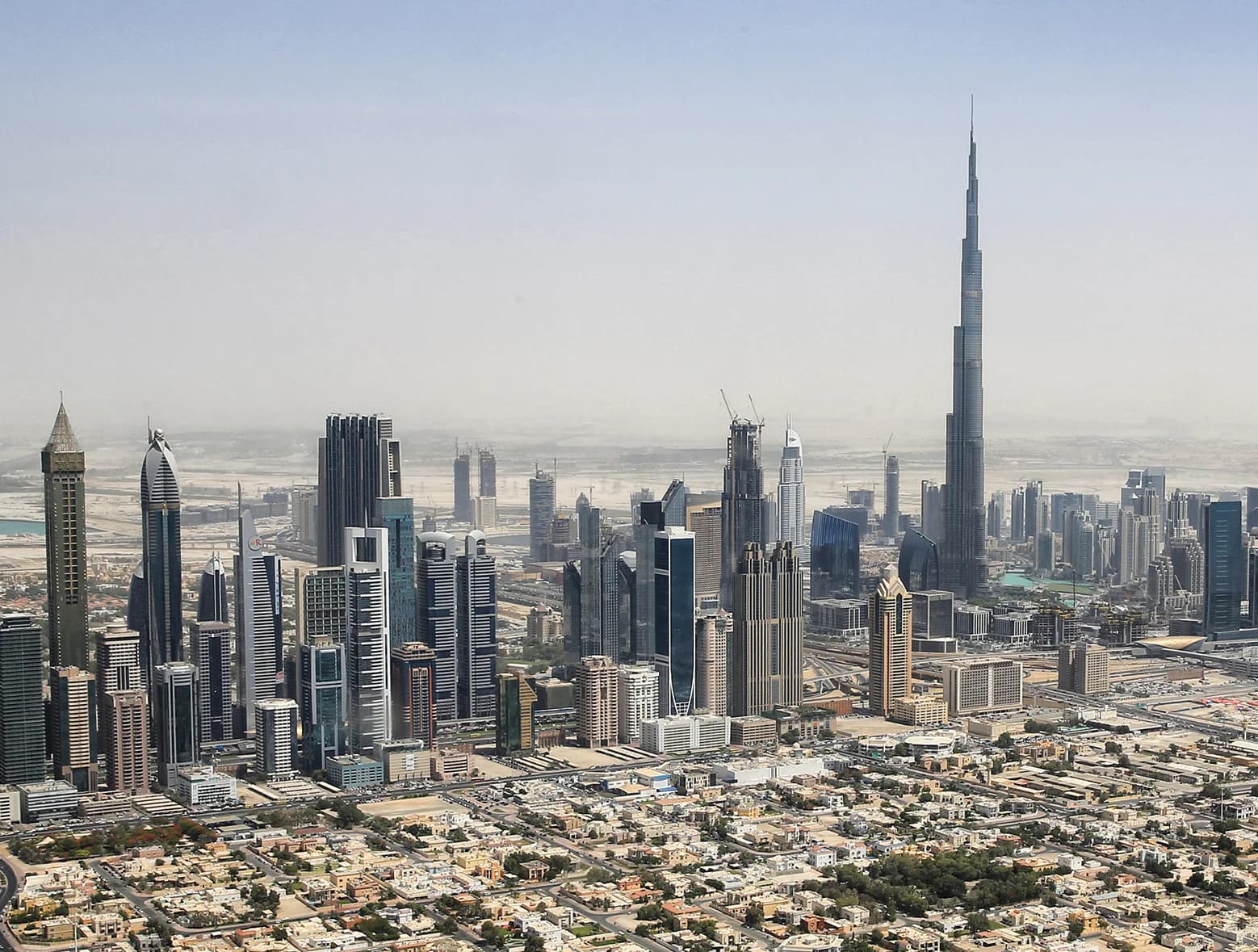
The Burj Khalifa, the world's tallest structure since its completion in 2010, is the monument around which Dubai has organised its identity: a spire of reinforced concrete and glass that rises 828 metres (more than twice the height of the Empire State Building) from the desert floor. The building is an engineering achievement so audacious that it has become, in a decade and a half, as recognisable a symbol of the city as the Eiffel Tower is of Paris — and the experience of ascending it, in an elevator that travels at 10 metres per second, to the observation decks on the 124th, 125th, and 148th floors (At the Top, Burj Khalifa SKY — the highest observation deck on Earth at 555 metres), is as close to flight as the earthbound traveller can come.
The view from the observation deck — the city reduced to a map beneath you, the Palm Jumeirah a delicate frond of artificial land extending into the Arabian Gulf, the desert a brown infinity on the eastern horizon, the Persian Gulf a sheet of turquoise on the western one — is staggering, and the experience of watching the sunset from this height, with the city's lights beginning to glitter in the desert dusk, is an essential Dubai moment. Book the SKY experience (the 148th floor, with a guided tour and access to the exclusive lounge) for the full experience, and book for an hour before sunset — the transition from day to night, from this height, is something you will never forget.
The Dubai Mall, at the base of the Burj Khalifa, is the world's largest shopping centre by total area, and it demands a strategy. The mall contains 1,200 retail outlets, an Olympic-sized ice rink, an aquarium (the Dubai Aquarium and Underwater Zoo, whose 10-million-litre tank — one of the largest suspended aquariums in the world — contains 33,000 aquatic animals including sand tiger sharks and giant groupers), a virtual-reality park, a complete dinosaur skeleton (a diplodocus from Wyoming, 155 million years old, 24 metres long, on display in the Grand Atrium), and a waterfall (the Human Waterfall, a four-storey structure of fibreglass divers frozen in mid-dive). The luxury wing — Fashion Avenue — is the essential destination for the luxury traveller: every major brand at flagship scale, an environment of marble floors, chandeliers, and the particular hush of serious money being spent. The shopping experience is, for those who enjoy it, among the finest in the world. For those who do not, the architecture is interesting for about an hour.
The Dubai Fountain, the world's largest choreographed fountain system at the base of the Burj Khalifa and the Dubai Mall, performs every thirty minutes from 6 pm to 11 pm: water jets shooting 150 metres into the air, choreographed to music (classical, Arabic, contemporary) in a spectacle that is — against all odds — genuinely moving. The best view is from the terrace at Thiptara (Thai restaurant at the Palace Downtown), or from a fountain-view room at the Armani Hotel Dubai (the hotel occupies the lower floors of the Burj Khalifa, and the rooms, designed by Giorgio Armani himself, are studies in understated beige elegance that defy the city's default mode of gold and marble).
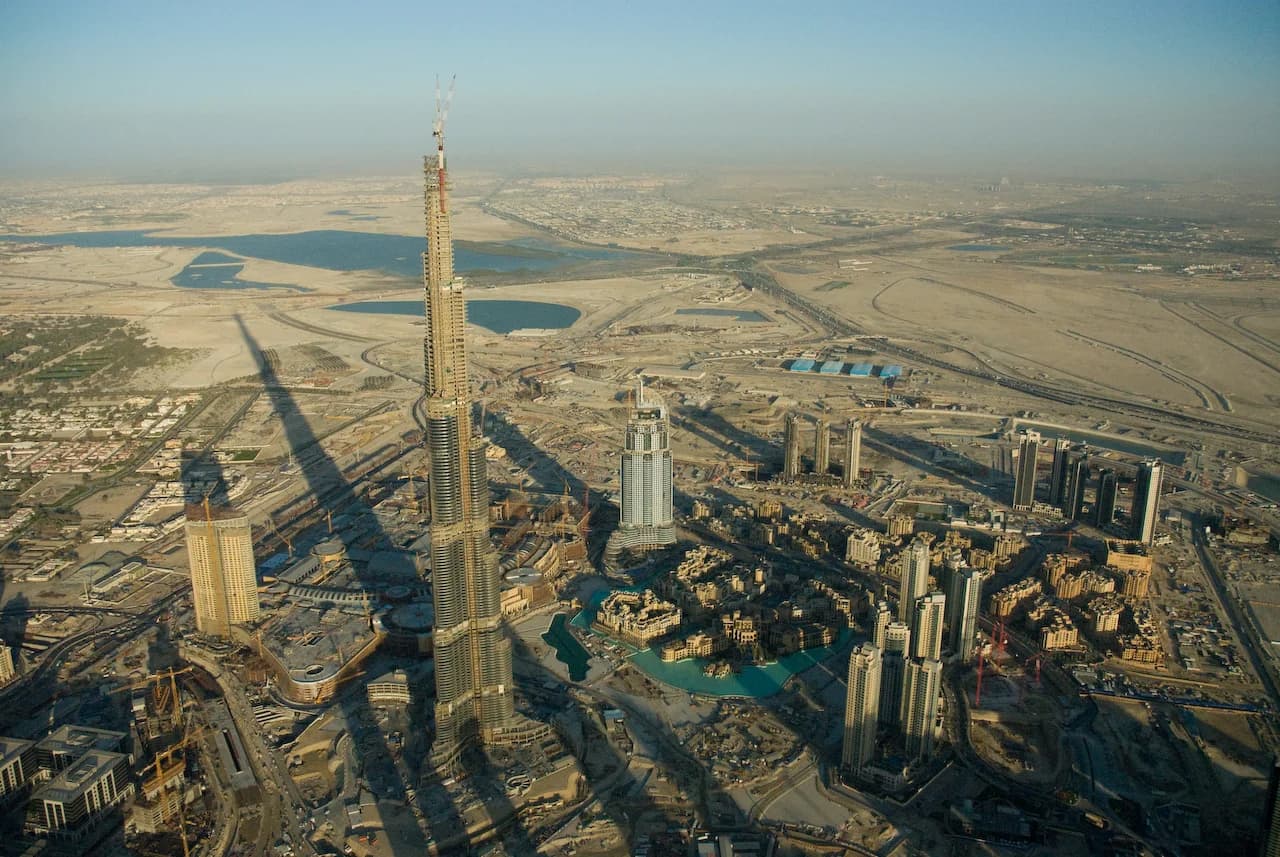
The view from At the Top, Burj Khalifa, 148th floor at sunset — the city a miniature beneath your feet, the Palm Jumeirah visible to the west, the Arabian Gulf and the desert meeting at the horizon, the curvature of the Earth just perceptible in the distance, the sense of standing on a human achievement so audacious that it provokes, simultaneously, pride in what we can build and disquiet at the cost of building it
The Burj Khalifa, designed by Adrian Smith of Skidmore, Owings & Merrill and completed in 2010, stands 828 metres tall with 163 floors, making it the world's tallest structure since its completion — more than twice the height of the Empire State Building (381m) and nearly three times the height of the Eiffel Tower (300m). The building's Y-shaped tripartite floor plan was inspired by the Hymenocallis (spider lily), a regional desert flower, and its buttressed core structural system, pioneered for this building, allows it to withstand wind speeds exceeding 240 km/h. The 'At the Top, SKY' observation deck on the 148th floor, at 555 metres, holds the Guinness World Record for the highest observation deck on Earth, and on clear days the curvature of the Earth is visible at the horizon from this height.
“In Dubai, we don't wait for things to happen. We make them happen.”
The Palm Jumeirah and the Beach Hotels
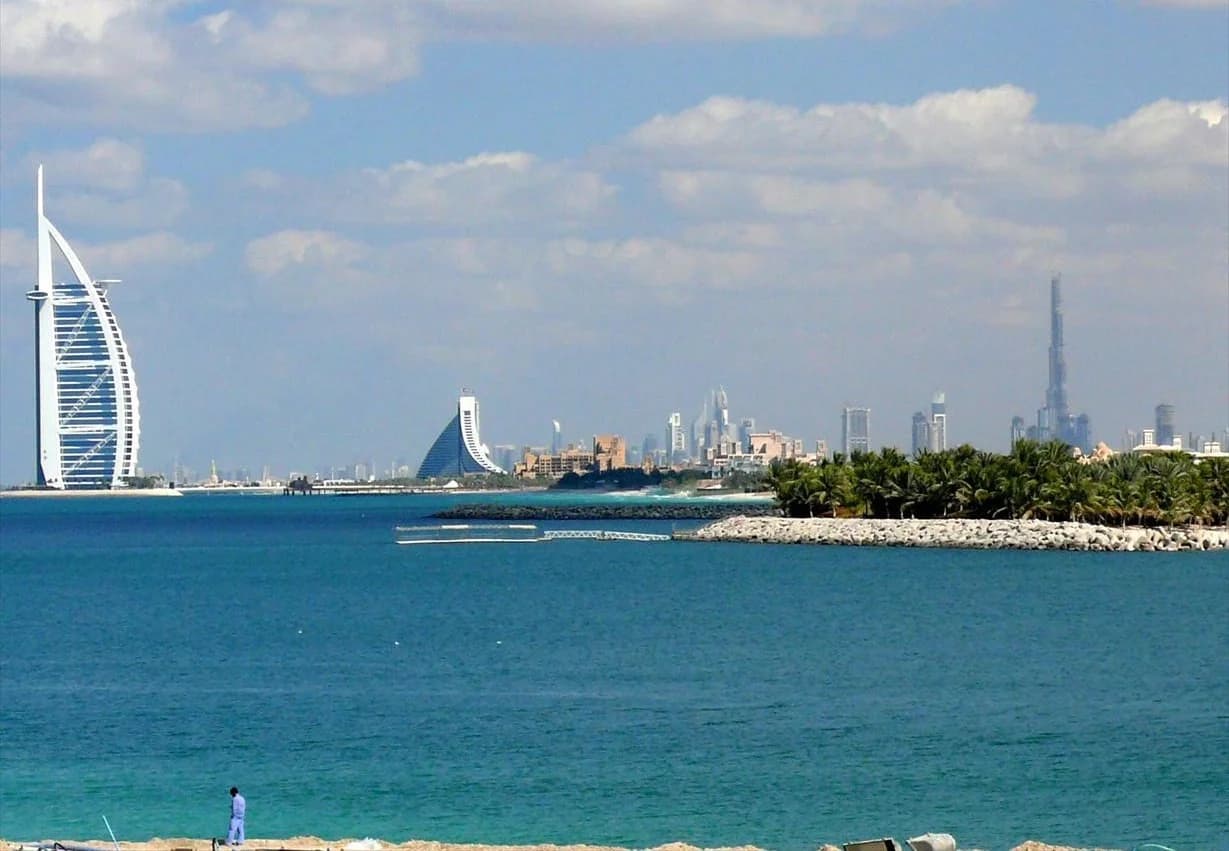
The Palm Jumeirah, the world's largest artificial archipelago, is the most visible symbol of Dubai's ambition — an island in the shape of a palm tree (a trunk, sixteen fronds, and an eleven-kilometre crescent breakwater) that has added 78 kilometres to Dubai's coastline and created some of the world's most extravagant hotel real estate. The Palm, seen from the air or from the observation deck of the Burj Khalifa, is a work of land art on a scale that the earth artists of the 1970s — Smithson, Heizer, de Maria — could never have imagined, and the experience of driving onto it from the mainland, the causeway disappearing behind you, the villas of the fronds on either side, the hotels of the crescent ahead, is a kind of dislocation — the sense of having left the real world for a constructed one.
Atlantis The Royal, opened in 2023, is the Palm's most ambitious hotel — a mega-resort on the crescent breakwater, designed by the American firm KPF with interiors by the French designer Sybille de Margerie, its central void an architectural gesture of such deliberate, spectacular drama (a stacked, 90-metre-high atrium open to the sky, water cascading down its walls, fire sculptures by WET Design illuminating the entrance) that it has become, within weeks of opening, Dubai's most Instagrammed building. The gastronomic programme — eight restaurants by celebrity chefs including Nobu Matsuhisa (Nobu by the Beach — a coastal iteration of the global brand), José Andrés (Jaleo), and Heston Blumenthal (Dinner by Heston Blumenthal, the Dubai outpost of the London original where the Meat Fruit — chicken liver parfait disguised as a mandarin — has become as famous as any dish in the city) — is the finest of any resort in the Middle East.
For a more intimate beach experience, One&Only Royal Mirage, on the mainland opposite the Palm, is a property of understated Arabian palace architecture (arches, courtyards, fountains, a kilometre of private beach) that offers a counterpoint to the glass-and-steel modernity of the newer resorts. The Moorish-style lobby, the extensive gardens (a million square metres of palms, bougainvillea, and formal parterres), and the service — Old World in the best sense, formal but warm — create an atmosphere of refuge that the city's more theatrical hotels cannot replicate. The Beach Bar & Grill, the hotel's seafood restaurant, with its terrace overlooking the Arabian Gulf and the Palm Jumeirah, is one of the most romantic dining settings in the city.
Atlantis The Royal at dusk — the central void a cascade of water and fire, the towers rising against a sky of deepening indigo, the Palm Jumeirah curving away into the darkness of the Arabian Gulf, the whole composition a statement of intent: Dubai, in the third decade of the twenty-first century, still believes in the power of architecture to astonish
Atlantis The Royal, opened in January 2023 with a grand launch performance by Beyoncé, was designed by architecture firm KPF and occupies a 406,000-square-metre site on the crescent of Palm Jumeirah, one of the world's largest artificial archipelagos. The hotel's defining architectural feature is its 90-metre-high central void between two towers, through which water cascades and fire sculptures by WET Design (the firm behind Dubai Fountain) create a spectacle visible from across the Palm. Palm Jumeirah itself, constructed between 2001 and 2008, added 78 kilometres of coastline to Dubai and required 94 million cubic metres of sand and 7 million tonnes of rock, creating an artificial landmass visible from space that has become the definitive symbol of 21st-century Dubai's ambition.
Old Dubai: The Creek, the Souks, and the History
Old Dubai — the city that existed before the oil, the towers, and the Palms — survives along the Dubai Creek, the saltwater inlet that was the original reason for the city's existence, a natural harbour on the trade route between Mesopotamia and the Indus Valley that has been a port for at least four thousand years. The Al Fahidi Historical Neighbourhood (formerly known as Al Bastakiya), the district of wind-tower houses built in the late nineteenth century by Persian merchants from the Bastak region, is the most complete surviving fragment of old Dubai — a collection of narrow alleys, courtyard houses, and the wind towers (barjeel, the traditional cooling system of the Gulf, a chimney of four triangular faces that captures the breeze and directs it into the rooms below) that were the definitive architectural feature of the pre-air-conditioned Gulf. The district, restored and curated, houses galleries (the Majlis Gallery, the XVA Gallery, both long-standing fixtures of the Dubai art scene), cafés, and the Sheikh Mohammed Centre for Cultural Understanding, whose motto — "Open Doors, Open Minds" — is realised in the guided tours, the cultural meals (the Emirati breakfast, the traditional lunch), and the Q&A sessions in which any question, on any subject, is welcomed.
The Dubai Creek, crossed by traditional wooden dhows (the sailing vessels that have traded between the Gulf, India, and East Africa for centuries, now serving as cargo boats for the trade that still flows through the Creek's ports) and the abras — the water taxis that have been carrying passengers across the Creek since before the invention of the automobile motor, a dirham token for a one-way journey — is Dubai's most atmospheric experience. An hour on a chartered dhow at sunset, with the wind towers of Al Fahidi on one bank and the souks of Deira on the other, is the essential connection to the Dubai that existed before the shopping malls and the supercars and the world's tallest everything.
The Gold Souk and the Spice Souk, in Deira, are the commercial heart of Old Dubai: a labyrinth of covered alleys where the city's gold trade (Dubai is one of the world's largest gold markets) is conducted in shops whose windows glitter with jewellery of every style and every carat. The gold is sold by weight and the price is negotiable. The Spice Souk — the same alleyways, the same merchants, but a different sensory register: the air thick with the smell of cinnamon, cardamom, saffron, frankincense, and the oud (agarwood) that is the essential fragrance of the Gulf — is a reminder of Dubai's role as the principal entrepôt of the Gulf-Arabia-Orient trade for centuries. The merchants, almost all from the Indian subcontinent or Iran, are happy to talk and happier to sell, and the price of a few grams of the highest-quality saffron in the Spice Souk is a fraction of what it costs in the luxury supermarkets of London. Buy it. Your cooking will thank you.
Dubai Creek at sunset — a dhow gliding across the water with its lanterns illuminated, the wind towers of Al Fahidi silhouetted against the western sky, the minarets of Deira on the far bank, a sense of timelessness that the towers of Downtown Dubai, visible on the southern horizon, do not so much contradict as frame — the past and the present of this extraordinary city, holding each other in a strange and beautiful tension
Dubai Creek (Khor Dubai) is a natural saltwater inlet that has served as a port for at least 4,000 years, functioning as the principal harbour on the trade route between Mesopotamia and the Indus Valley civilisation. The Al Fahidi Historical Neighbourhood (Al Bastakiya), built in the late 1890s by Persian merchants from Bastak in southern Iran, preserves the last substantial collection of traditional wind-tower houses (barjeel) in the Gulf — passive cooling structures with four triangular faces that capture breezes and channel them downward into living spaces, a pre-electricity architectural innovation that could reduce interior temperatures by up to 10°C. The dhows that still ply the Creek carry cargo between Dubai, India, and East Africa using the same lateen-rigged design that Arab sailors employed for Indian Ocean trade during the medieval period, when the Gulf ports were among the most important commercial hubs in the world.
The Desert: Al Maha and the Empty Quarter
The desert is the reason Dubai exists at this particular location — an oasis on the trade route between the Gulf and the interior of Arabia — and the experience of leaving the city for the dunes that begin twenty minutes from the last skyscrapers is the essential counterpoint to the urban intensity of the towers, the malls, and the Palms. The Dubai Desert Conservation Reserve, 225 square kilometres of protected desert about an hour's drive from the city, is the most accessible encounter with the Rub' al Khali — the Empty Quarter, the largest sand desert on Earth, which extends from the UAE south into Saudi Arabia, Oman, and Yemen.
Al Maha, a Luxury Collection Desert Resort & Spa, is the definitive Dubai desert experience — forty-two Bedouin-tent suites set among the red dunes of the reserve, each with its own plunge pool, its own dune view, and its own tribe of oryx and gazelles (the Arabian oryx, extinct in the wild in 1972, has been bred back from captivity at Al Maha and other reserves, and the animal that was the source of the unicorn myth — in profile, its two horns appear as one — now wanders the reserve in a herd of several hundred). The suites — canvas-walled tents with hand-crafted furniture, antiques from the region, and modern bathrooms — balance luxury and authenticity with a skill that few desert camps, anywhere in the world, can match. The activities — camel trekking at dawn, falconry (the peregrine falcon, the hunting bird of the Bedouin, stooping at 390 kilometres per hour is the fastest animal on Earth; the demonstration of this fact, from the glove of a falconer on a dune at sunset, is an experience that no visitor forgets), archery, wildlife drives — are expertly guided, and the landscapes — the dunes, the ghaf trees, the silence — are the antidote to Dubai that Dubai, with characteristic thoroughness, has provided for itself.
A night or two at Al Maha, or at the more accessible Bab Al Shams (a desert resort of Arabian courtyards and rooftop bars, nearer the city and correspondingly less expensive), is the essential pause in a Dubai itinerary — the silence after the noise, the emptiness after the density, the history before the future. The desert, the oldest landscape on Earth, is the most modern form of luxury.
Decoding the Dress Code
Dubai is a conservative Muslim city in an Islamic country, and the dress code — while more relaxed than in Saudi Arabia or Oman — is enforced. Shoulders and knees covered for both men and women in public spaces (malls, souks, government buildings). Swimwear is for the beach and the pool — that bikini is perfectly acceptable at the One&Only or the Bulgari Resort beach, but you need to cover up before you leave the sand. Public displays of affection (holding hands is fine, anything beyond that is not) are discouraged, and public intoxication is a criminal offence. The malls play announcements reminding visitors of the dress code. They mean it.
Frequently Asked Questions
When is the best time to visit? November through March, when daytime temperatures are 24-30°C and the evenings are cool enough for outdoor dining. December through February is peak season — the hotels are full, the rates are at their highest, and the restaurants are booked days in advance. April and October are shoulder months with pleasant weather and fewer crowds. May through September is summer — 38-50°C and humidity that makes outdoor activity impossible between 10 am and 4 pm. The hotels offer dramatic summer discounts, and the indoor, air-conditioned Dubai (malls, museums, ski slope) is largely unaffected by the heat.
How many days do I need? Four full days is a satisfying minimum: one for the Burj Khalifa, the Dubai Mall, and Downtown, one for Old Dubai (Al Fahidi, the Creek, the souks), one for the beach and the Palm, and one for the desert. Five to seven days allows for a deeper immersion and a night or two at a desert resort.
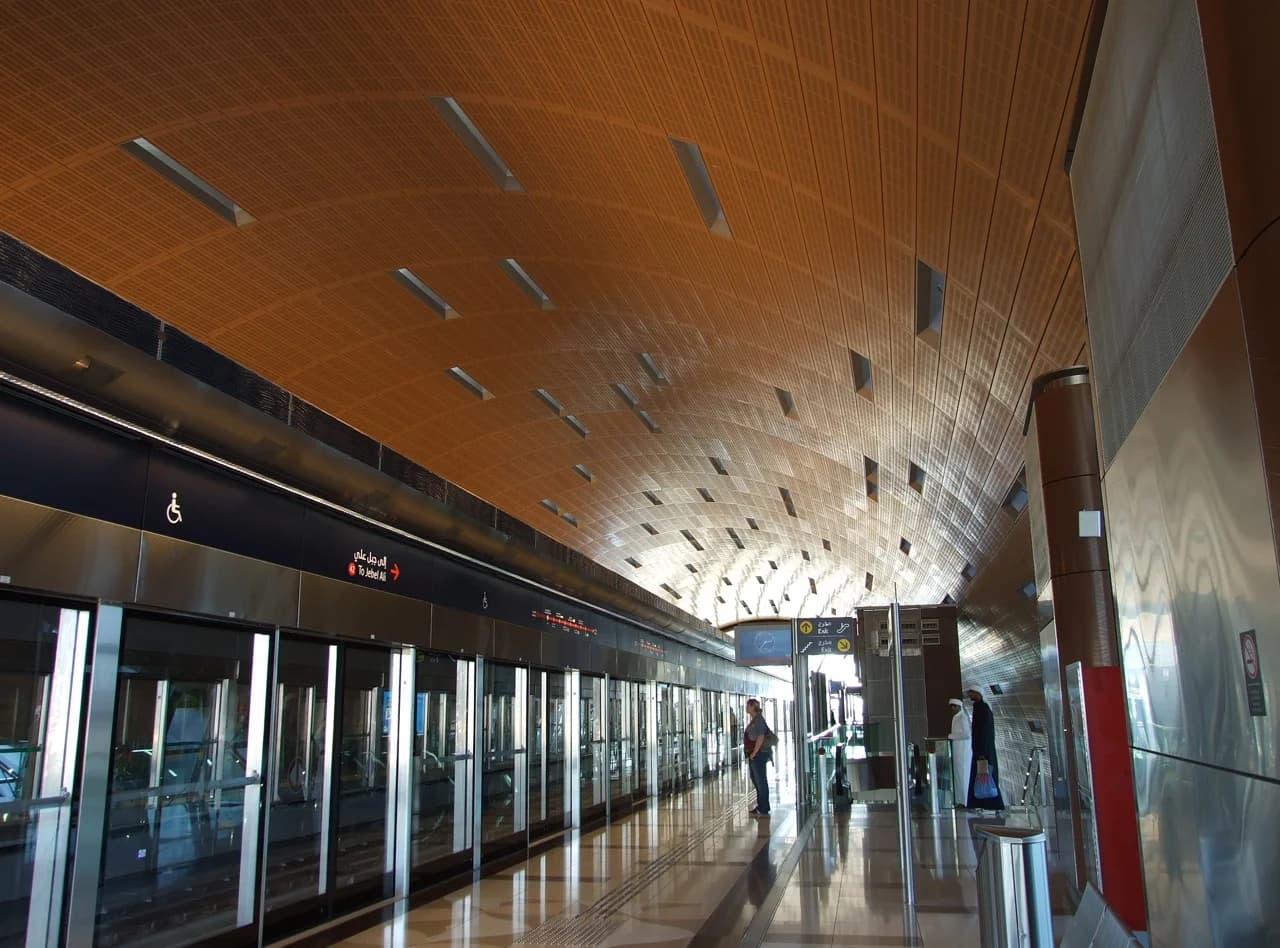
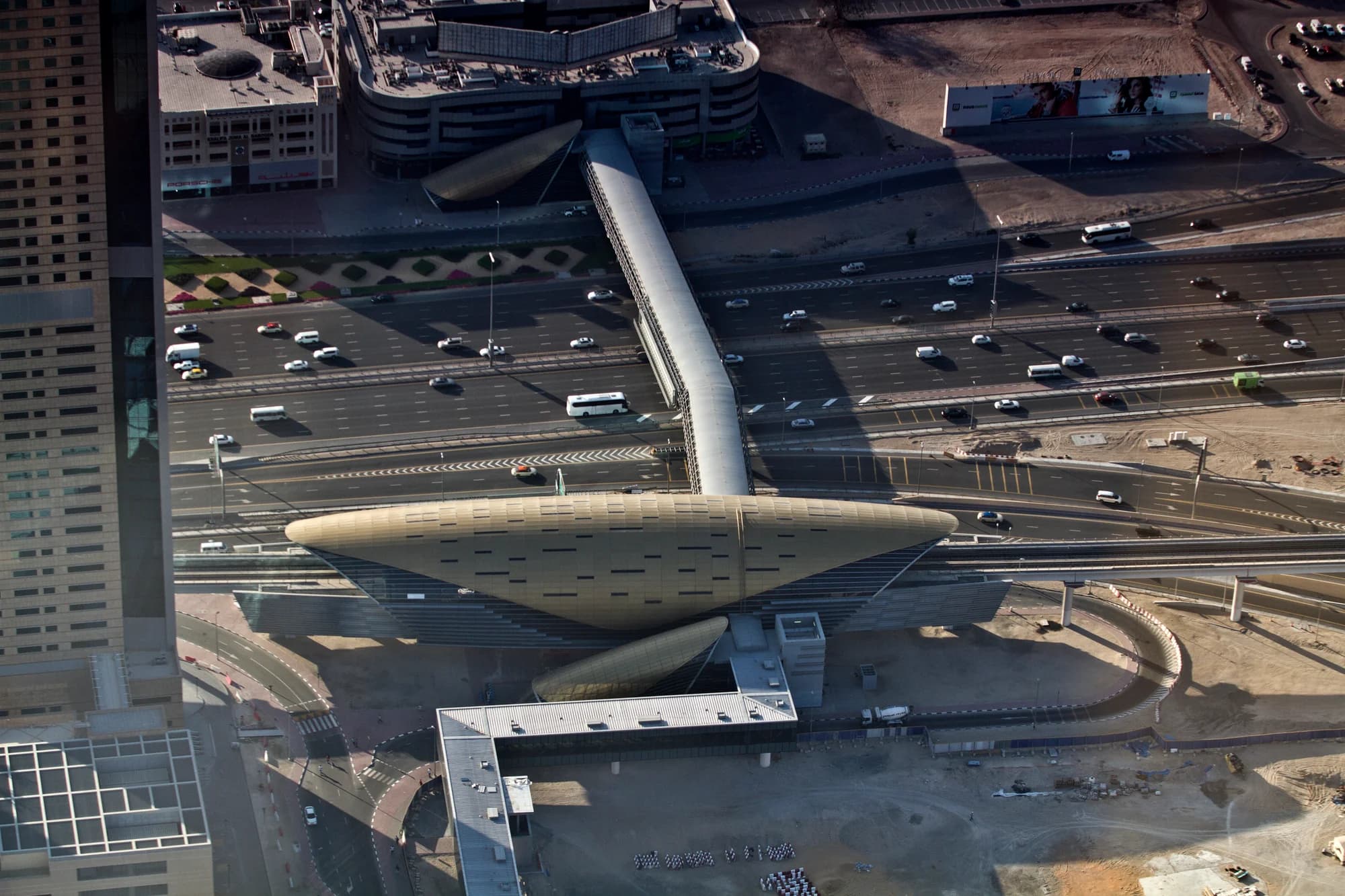
How do I get around? The Dubai Metro is clean, efficient, and covers the spine of the city (the Red Line from Dubai International Airport, through Downtown, Dubai Marina, to the Jebel Ali Industrial Area). It is the best way to travel between Downtown and the Marina. Taxis are metered, relatively inexpensive, and plentiful. Ride-hailing services (Uber, Careem — the local equivalent, owned by Uber) are ubiquitous. A car is useful for a day trip to Abu Dhabi or the desert but unnecessary within the city.
Is Dubai expensive? Yes, at the luxury end — among the most expensive cities in the world. A three-starred dinner: $500-1,000 per person. A hotel at the top tier: $600-3,000 per night. A glass of champagne at a rooftop bar: $30-50. And at the other end: a shawarma from a street stall in Deira: $3. An abra across the Creek: 31 cents. Dubai is a city of extreme contrasts, and the luxury experience exists alongside a city of immigrant labourers and budget realities that the glass towers of the Marina are designed, both literally and metaphorically, to obscure.
The Arabian Desert at sunset from the dunes of the Dubai Desert Conservation Reserve — the sand a sea of red and gold stretching to the Empty Quarter, the oryx moving across the dune face like pale ghosts, the silence so complete it is a physical presence, the sky a vast canvas of rose, gold, and violet, the desert that created this city and that surrounds it, still, on every side — waiting, patient, eternal, indifferently beautiful
The Dubai Desert Conservation Reserve, established in 2003, protects 225 square kilometres of the northernmost extension of the Rub' al Khali (the Empty Quarter), the largest contiguous sand desert on Earth, covering 650,000 square kilometres across Saudi Arabia, Oman, Yemen, and the UAE. The Arabian oryx (Oryx leucoryx), the national animal of the UAE, was declared extinct in the wild in 1972 — the last wild individual was shot in Oman — but a captive breeding programme initiated at Phoenix Zoo, Arizona, and later expanded at Al Maha resort, has successfully reintroduced the species, with over 1,200 now roaming protected reserves across the Arabian Peninsula. The red dunes of the reserve, coloured by iron oxide coating grains of quartz sand weathered from the Hajar Mountains over millions of years, can reach heights of 40 metres and shift with the shamal winds that shape the landscape of eastern Arabia.