The Golden Age of Royal Bespoke Automobilia
Long before the motor car was a consumer appliance, it was an aristocratic instrument of statecraft and aesthetic projection. In pre-independence India, the relationship between the princely states and European coachbuilders represented the most extravagant era in automotive history. Between 1907 and the outbreak of the Second World War, an estimated 800 Rolls-Royce chassis were shipped directly from Derby and Springfield to the subcontinent, each ordered to the exacting and frequently eccentric specifications of reigning Maharajas, Nizams, and Nawabs.
These were not factory-standard bodies. Chassis were delivered in bare mechanical form to the premier coachbuilders of London and Paris — Barker & Co., Hooper, Thrupp & Maberly, and Kellner — where craftsmen fashioned aluminium, teak, German silver, and ivory into bespoke vehicles. The Maharaja of Patiala, Bhupinder Singh, rarely ordered single automobiles; he ordered suites of six or twelve, finished in imperial canary yellow and crimson, equipped with rifle racks, silver sun-visors, and custom scuttle-mounted brass searchlights designed for night tracking through the Siwalik foothills.
Yet what distinguishes these motor cars from ordinary historic vehicles is that they were built without commercial compromise. In an age when European roads were rudimentary, the Indian princes required chassis reinforced against extreme heat, monsoon deluges, and the rocky terrain of the Deccan plateau. Heavy-duty tropical radiators, louvred bonnets with enlarged cooling scoops, dual dynamos, and bespoke nickel-plated water pumps transformed British engineering into resilient desert machinery.
“Between 1907 and 1940, India's royal houses commissioned nearly twenty percent of all motor cars built by Rolls-Royce — none of them standard.”
Inside the Living Garage of Udaipur
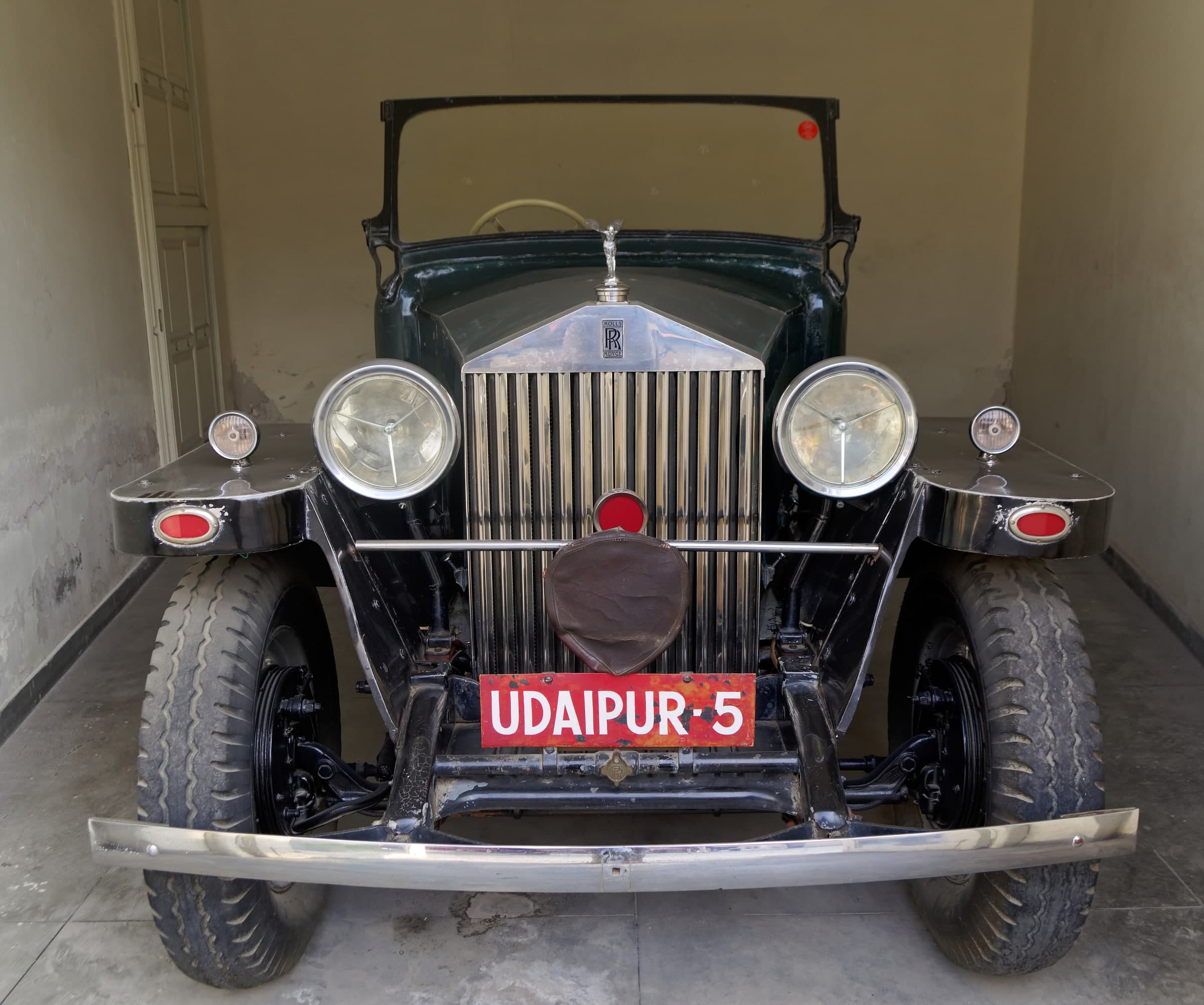
Nowhere is this legacy more palpable than in the Vintage & Classic Car Museum of Udaipur, situated in the former Mewar State Motor Garage. Maintained under the direct stewardship of the House of Mewar, this collection is not a static museum display where vehicles gather dust behind velvet ropes. Every car in the collection is kept in operational order, its mechanical linkages lubricated, its dual-ignition magneto coils serviced, and its coachwork polished with carnauba wax by hereditary palace mechanics whose grandfathers tuned the same straight-eight engines.
The jewel of the collection is the 1934 Rolls-Royce 20/25 HP with four-door saloon coachwork, winner of the prestigious Lucius Beebe Trophy at the Pebble Beach Concours d'Elegance. Driven across Udaipur's lakeside roads during royal processions and family ceremonies, the car embodies the living continuity of Rajput royalty. Beside it rests a 1934 Phantom II with sports touring bodywork, a 1946 Jaguar Mark IV, and a collection of custom 1938 Cadillacs ordered with reinforced suspension to ferry dignitaries between the City Palace and Jagmandir Island.
What strikes the discerning eye is the restraint of the Mewar vehicles. Unlike the theatrical chrome flourishes favoured in northern princely courts, the Udaipur garage favoured quiet dignity: deep bottle greens, dark midnight blues, understated Connolly leather interiors, and walnut dashboard timber polished until it reflects the stone courtyards of the Aravali palace complex.
Shikar Cars, Armour Plating and Ceremonial Opulence
The royal garages were laboratories of bespoke mechanical innovation. The sport of shikar (royal hunting) demanded vehicles that could traverse dense sal forests and dry riverbeds decades before the advent of production four-wheel drive. Barker & Co. responded by creating high-clearance 'shikar saloons' fitted with hand-cranked secondary winches, dual spare tyres mounted on running boards, swivelling step-board spotlights, and detachable leather gun cases tailored to match the pigskin upholstery.
In Hyderabad, the seventh Nizam — then reputed to be the wealthiest individual on earth — ordered a 1912 Rolls-Royce Silver Ghost with high-domed coachwork styled to resemble a ceremonial state throne. Finished in rich royal blue with gold-leaf heraldic filigree, the Nizam's state car featured a scuttle-mounted silver snake that doubled as an exhaust-driven horn, summoning crowds to clear the roadway as the sovereign passed through the Charminar.
Other princes indulged personal whims with technical sophistication. The Maharaja of Alwar ordered cars fitted with internal air-cooling boxes filled with dry ice and copper evaporators to circulate chilled air decades before automotive air conditioning was patented in Detroit. The Maharaja of Nabha commissioned a vehicle built entirely in the form of a mechanical swan, complete with beak-mounted steam jets, glowing red glass eyes, and an eight-note Gabriel exhaust horn that played liturgical ragas.
“Unlike Western cars that passed through dozens of auctions, Indian royal cars frequently remained in single family garages for generations, preserving their original living patina.”
The Renaissance of Indian Automotive Heritage
For decades following the abolition of the privy purses in 1971, many of these extraordinary vehicles faced uncertain fates. Export bans enacted under the Antiquities and Art Treasures Act of 1972 prevented the flight of historic coachwork abroad, but domestic parts availability made maintenance an uphill battle. It is only in the past fifteen years, through the resurgence of premier events like the 21 Gun Salute Concours d'Elegance and the Cartier Travel with Style Concours, that the full cultural value of India's automotive heritage has been globally recognised.
International judges and collectors from Pebble Beach, Villa d'Este, and Goodwood now acknowledge that India possesses the world's most intact repository of early 20th-century coachbuilt machinery. Unlike Western collections where cars passed through dozens of auction houses and underwent multiple speculative restorations, Indian royal cars frequently remained with single families for three or four generations, preserving original patinas, upholstery stamps, and hand-beaten aluminium panels.
Today, a new generation of royal custodians is taking active leadership. Automotive restoration workshops in Jodhpur, Jaipur, and Ahmedabad employ traditional metal-shaping wheelwrights alongside modern spectroscopic paint analysts, ensuring that when a 1930s Phantom rolls out of a Rajasthan stable, it speaks not of nostalgia, but of living aristocratic craft.
The Royal Gallerys Perspective
To view the Maharaja's garage through the lens of mere consumption is to miss its historical reality. In the first half of the twentieth century, these motor cars served the same institutional role as royal elephants, ceremonial howdahs, and durbar regalia: they were visual anchors of sovereignty and artistic patronage.
As the international collectors' market increasingly prioritises unrestored originality and ironclad provenance over mirror-finish over-restoration, India's surviving royal garages occupy an unassailable position. They remind us that the pinnacle of bespoke luxury is never off-the-rack perfection — it is the singular vision of a patron brought into being through the hands of master artisans.
THE ROYAL GALLERYS is the international magazine for heritage, culture and luxury — documenting the people, places and ideas shaping the worlds of royalty, jewellery, design, travel and contemporary life. Our editorial authority rests on deep engagement with India's cultural ecosystem and a commitment to telling the stories that matter.
For editorial inquiries, story proposals, and partnership discussions, contact our editors at hey.theroyalgallerys@gmail.com.
Rohan Varma
Senior Motoring Editor. THE ROYAL GALLERYS is the international magazine for heritage, culture and luxury — editorial authority on the people, places and ideas shaping our world.
Part of Motoring
This article is part of THE ROYAL GALLERYS Motoring section — our international editorial destination for motoring, heritage and luxury.
Explore All Motoring Stories →