The 1933 Patent: The Elimination of Metal
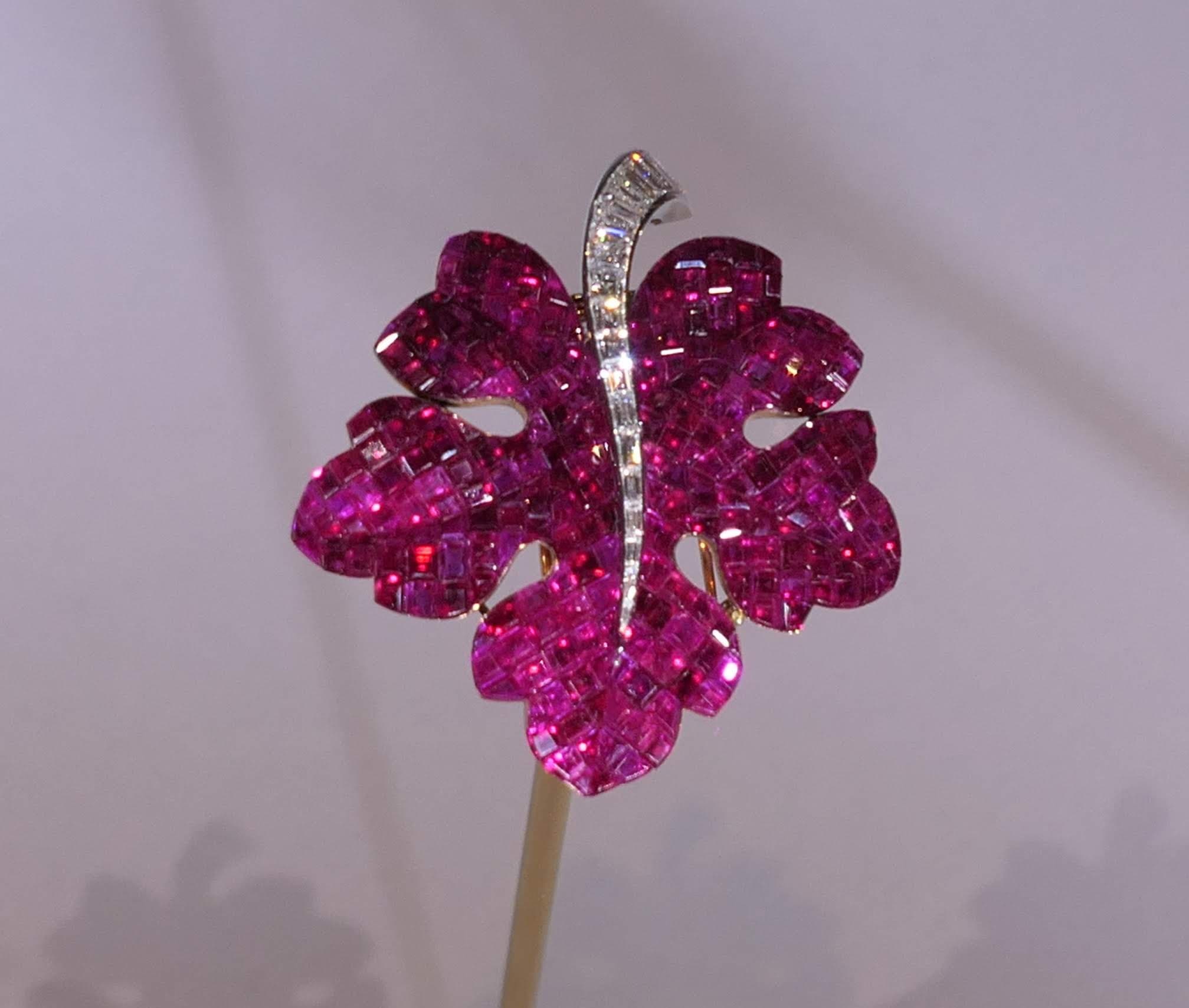
In the long history of gemmological craftsmanship, few breakthroughs have had as profound an aesthetic impact as the patent registered by Van Cleef & Arpels on 2 December 1933. Granted under the title *Serti Mystérieux* (Mystery Setting), the technique achieved an ambition that jewellers had pursued for centuries: mounting faceted gemstones across curved, dimensional surfaces with zero visible metal prongs or bezels.
Before 1933, every precious stone required claws or metal rims to hold it fast. However delicate the goldsmith’s touch, metal inevitably interrupted the continuity of color. The Mystery Setting inverted this paradigm. By hiding the metal framework entirely beneath the gems, Van Cleef & Arpels allowed stones to touch girdle-to-girdle, transforming rigid minerals into fluid, velvety draperies of pure color.
“By hiding the metal framework entirely beneath the gems, Van Cleef & Arpels transformed rigid minerals into fluid, velvety draperies of pure color.”
The Anatomy of Perfection: Grooves, Rails, and Calibrated Gems
Executing a single piece in Serti Mystérieux is a feat of staggering micro-mechanical precision, requiring upwards of 300 to 500 hours of atelier labor. The process begins with the lapidary. Hundreds of natural gemstones — traditionally pigeon-blood Burmese rubies or velvety Kashmir sapphires — must be chosen with identical hue, saturation, and refractive index.
Each stone is then faceted with exacting calibration: a square, rectangular, or triangular pavilion. Crucially, the cutter carves microscopic horizontal grooves into the facets of the pavilion just beneath the girdle. Meanwhile, the goldsmith constructs a delicate underlying lattice of gold or platinum rails, shaped like tiny T-bars. One by one, the stones are slotted onto these rails and slid into place until they click. If a groove is a fraction of a millimetre too shallow, the stone will not slide; if it is a fraction too deep, the stone will shatter under tension.
Because no stone can be forced, the margin for error is absolute zero. Even today, with advanced microscopic optical tools, only a handful of *Mains d’Or* (Master Craftsmen) in the Van Cleef & Arpels High Jewellery ateliers on Place Vendôme possess the requisite touch.
Sovereign Patrons and Poetic Naturalism
What elevated the Mystery Setting from an engineering novelty to fine art was Van Cleef & Arpels' commitment to naturalistic poetry. Rather than producing flat geometric mosaics, the maison used the technique to mimic the undulating folds of petals, draperies, and feathers.
Iconic creations such as the Chrysanthemum Clip (1937), the Peony Clip (1937, acquired by Princess Faiza of Egypt), and the delicate floral brooches favored by the Duchess of Windsor and Princess Grace of Monaco demonstrated how the technique could imbue rigid gems with organic life. The Duchess of Windsor was among the maison's most passionate champions, commissioning bespoke Mystery Set ruby and diamond feather clips that captured the glamour of pre-war European society.
“If a stone's groove is a fraction of a millimetre too shallow, it will not slide; if too deep, it shatters under tension. The margin for error is zero.”
The Contemporary Legacy of the Mains d’Or
In recent decades, Van Cleef & Arpels has pushed the boundaries of the Serti Mystérieux even further, developing the Vitrail Mystery Set (where translucent gems are set without backing to allow light to pass through) and applying the technique to emeralds — a stone whose notorious brittleness had previously made invisible grooving nearly impossible.
For high jewellery collectors, an authentic vintage or contemporary Mystery Set piece remains one of the ultimate acquisitions in decorative art. When such masterworks appear at Sotheby’s or Christie’s in Geneva, they routinely command multimillion-dollar valuations, celebrated not merely as precious adornment, but as the supreme triumph of human patience over mineral resistance.
THE ROYAL GALLERYS is the international magazine for heritage, culture and luxury — documenting the people, places and ideas shaping the worlds of royalty, jewellery, design, travel and contemporary life. Our editorial authority rests on deep engagement with India's cultural ecosystem and a commitment to telling the stories that matter.
For editorial inquiries, story proposals, and partnership discussions, contact our editors at hey.theroyalgallerys@gmail.com.
Éloïse de Saint-Germain
Haute Joaillerie Historian, Paris. THE ROYAL GALLERYS is the international magazine for heritage, culture and luxury — editorial authority on the people, places and ideas shaping our world.
Part of Jewellery
This article is part of THE ROYAL GALLERYS Jewellery section — our international editorial destination for jewellery, heritage and luxury.
Explore All Jewellery Stories →